The Last Hodges Mission Letter from South Sudan! ...and the next thing for the Hodges
Dear Friends and Supporters,
It is once again time for Steve and I to make a major mission transition. My time of four years with Individual Volunteers in Mission is ending the end of May (Steve's ended March, 2013). I will be moving to Kampala, Uganda, to seek what God has in store for me there. This will put Steve and I in the same location again!! Your continued prayers and financial support has enabled and upheld the mission here so far. Continued support through this transition will be appreciated (see details below).
Situation in South Sudan: Please continue to pray for peace, as some steps have been taken both parties but conflict continues in places. There have not been any incidents in Yei since I have been here, and the road I will take leaving the country is expected to be secure.
Finishing my work in South Sudan: I have completed training of about 200 traditional birth attendants. It is amazing how everything has come together at the end. With Dr. Sharon Fogleman's help I have spearheaded creating a training program for women who have had little to no previous education. They have learned how to recognize pictures and use them as reminders (my last ah-ha was seeing I had to teach them how to use the papers as a memory tool. You can't assume anything).When I first came, they would hardly acknowledge the existence of the government health clinics. Now when I have them role play how to talk to a pregnant women with a risk factor or complication, they say “I can't do anything for you at home. You must go to the clinic. If your husband isn't here, I will take responsibility. Let's go”. They have been teaching their women in the churches about safe pregnancy and birth, with the pictorial manual I have written for them, and now have digital audio players, with a recording. I am hearing confirmation that more women calling the TBAs for birth, instead of giving birth alone. There are even some men who are more willing to send the woman to the clinic, than the woman themselves (this represents a big cultural change from just letting things happen at home, as has been done in the past). The TBAs are using the bulb syringes to help the babies breathe at birth (the greatest cause of infant death) and can demonstrate how to stop the mother bleeding too much after the birth (the greatest cause of maternal death). These techniques are often not even known in the rural health clinics. They receive the training as a blessing, with thanksgiving and gratitude. They have been organized into local TBA learning groups, and will be meeting regularly among themselves, and going to their local health clinics to reinforce their skills, learning and relationship for referral. Dr. Lynn and Dr. Sharon Fogleman will be following up on these groups, as the move into their new plan of supporting and mentoring staff at these health clinics. The Foglemans will continue working here also adding focus on malaria, HIV, and other common diseases. I have trained and been assisted by 5 different South Sudanese women and we have all become very close. This, too has been a blessing. It has been amazing how God has directed this hand over to be successful.
I have been encouraging and monitoring each church to build a pit latrine, using donations from Wytheville District (Holston Conference), private donations and Yei Community Based Health Advance Special. The money provides nails, metal roof and timbers, and the people build the rest with local materials. It has been a long process and will be completed before I leave (pray for the one church which hasn't organized itself to do this project yet). Latrines not only keep the surroundings cleaner but save lives especially of children, who suffer from diarrhea from lack of sanitation.
All of us here on the UMC team have started seeing more progress in all the programs, especially in some of the churches. It is rewarding to see, after so many years of dedicated effort.
How to support the ongoing work of UMC in South Sudan (to be carried out by the Foglemans after Diantha leaves): Make donations at www.umcmission.org to Advance Special South Sudan HEAL #33021298 by entering the number in the search bar. (when doing this, make sure the number and title match, don't confuse it with “South Sudan Health Clinic” which is not in Yei, and not our project.)
Diantha and Steve Hodges' Emerging Ministries in Uganda: the next thing.
What does emerging ministry mean? During these four years Steve and I each have identified our calling for our contribution in this new African context. We know the gifts and vision that we can bring. Time and support is needed to allow each of our individual ministries to develop in a new location.
We have been led to serve in Uganda..Some conditions especially in the rural areas are very similar to South Sudan. Uganda also has a serious situation with lack of adequate health services, and extremely high infant and material mortality. Steve's work with Agricultural Risk Management is cutting edge there – no one else is doing it – and very much needed to help small scale farmers succeed and get the financing they need to grow their farming into a successful business.
Diantha's calling: My heart is in grassroots public health education, especially for birth. I believe in work which changes communities. My contributions in Uganda may be as a volunteer for some things, or I may find another organization for whom I can work, hopefully doing things similar to those I did in South Sudan. As I mentioned in my last newsletter, one thing I will do for a few months is help Africa ELI (Education Leadership Initiative, see www.africaeli.org____) explore starting a branch in Uganda in order to help more girls get a better education. Donations are needed to Africa ELI to cover travel expenses for Diantha plus 2 founders to visit potential partners, and for other start up costs (about $750).. ELI does not have any funds in their existing budget for these expenses.
Steve's calling: My heart is in helping small scale farmers succeed in growing their farming operation into a commercial agricultural business so they bring more income to their families and escape poverty. To do this, they need financing from banks and others; but farming is so risky that there is a need to look at all the risks that might threaten the success of an agricultural enterprise, and make a plan to reduce the most important risks. That's what my agricultural risk assessment, planning and management services do. Though I'm doing it as a business – a business with social purposes -- at times I've provided free or discounted work for farmer groups or universities who are interested in including this approach in education for agricultural and financial professionals. The banks, consulting firms and NGOs that hire me are paying full price. So far my social enterprise business is not quite covering expenses, but as it emerges eventually it will, since it is serving a valuable need that no one else is serving. My goals for my social enterprise business is (1) to help small scale farmers in Uganda (and after some years, in South Sudan) become commercially successful (2) to make enough money to cover expenses and support myself (3) to train a number of young Africans in the knowledge and methods of what I am doing so they can carry it on.
Accountability: We are forming an accountability committee of several people, to witness and help discern these new ministries. We are submitting a budget and will keep them informed. If you or your church is interested in taking this journey with us, please let Diantha know at dianthah@yahoo.com or in facebook message, so you can be updated as things develop.
We are asking for some of our supporters to take the leap of faith with us, to enable us to explore what new things God has for us to do in Uganda. In our experience, it is no surprise that the time for moving is almost here, and our funding is not yet defined. God has been leading and opening doors. But we have to trust and wait for the last minute!!
Finances: Our financial status for the next few months is not yet clear to us. Due to restricted funds, we will not be returning to the U.S. in June for Annual Conference, or visiting churches. We will need some help to transition into a new location for the next several months (we are projecting 3 to 6 months) until the next steps become clear. We will have moving expenses, monthly visas, new down payment for rent, and will need to buy furniture, etc. We have drafted a 6 month budget for $16,345.
How to donate: If you want to support us, do not send donations to IVIM (Advance Special #982465) as that chapter is finished. The chapter in South Sudan has closed, and a new one will open in Uganda. There are no other options available to us to receive mission support under the umbrella of GBGM of UMC, as we have done in various ways over the last 27 years. Ginghamsburg UMC in Ohio has offered the services of their finance office to help receive and pass on donations for this emerging ministry. It is not a ministry out of Ginghamsburg church, nor supported by their budget. We are very blessed to have this assistance.
Emerging Ministries: (tax exempt) Send Checks to Ginghamsburg UMC (memo: Hodges Emerging Ministries), 6759 S. County Road. 25A, Tipp City, Ohio 45377.
Online: at www.ginghamsburg.org. Click “give on line” and set up your account. Choose one-time or recurring donation. Then click “support our missionary”. WRITE IN NOTES: Hodges Emerging Ministries.
Africa ELI: Please send tax exempt donations here if you want to support this part of Diantha's work. This includes a need for an expense account of about $750 including to travel, to visit potential partners. send a designated check or go online at www.africaeli.org to Uganda Outreach Project in the comments line to: Africa ELI, 1550 Centervue Crossing #107, Knoxville, TN 37932. For the rest of my work in public health education, maternal and child health and birth work, send it to the arrangement for our Emerging Ministries.
Thank you so much for everything that has been done for us, for prayers and support. Please inform your missions committee, and finance officers of these changes. Also please reply to this email to dianthah@yahoo.com if you wish to follow these developments and receive further emails.
Blessings,
Diantha and Steve Hodges.
Tuesday, May 27, 2014

Saturday, November 30, 2013
Diantha Hodges Mission Letter November/December 2013 South Sudan dianthah@yahoo.com
Dear Friends and Supporters,
There are many challenges to living and working here. I know that this work cannot be done by myself alone. Thank you for the support all have been giving me: the financial support, the prayer support and the personal support, and prayer for Steve's transition to his agricultural risk management work. As Partners in Mission, I want to alert you to a special opportunity through the United Methodist Church. Tuesday, December 3 is a special day of giving, called # Giving Tuesday (after good response last year to Thanksgiving time donations). All on-line gifts given to UMC Advance Special offerings on this day will be matched dollar for dollar. If you are able to help out, there are instructions below. Finances for my programs come from the Advance Special S Sudan HEAL, and My personal support also comes through Advance Special for Volunteers in Mission. Thank you!!
Living here provides many examples of the stark reality of challenges and devastation within human lives: I have not met a person who does not have a story of struggle or tragedy, in the present or recent past. And many of them are not directly war related, but perhaps partly a result of disrupted families and communities. Besides the tragedies of families being broken up by death, multiple marriages that don't work out which leave children and women without support, there is poverty, the challenges of lack of access to education, terrible roads and communication systems, poor health care . Where are these people not vulnerable?
The story of Jesus' birth is also a story of vulnerability: this baby was born to a young woman who became pregnant before marriage and a poor unnoticed carpenter; in a stable, at a time of political unrest. The first announcements were to traveling foreigners and to the shepherds, people who were most looked down on. During his life, Jesus reached out to and healed every kind of outcast or sick, suffering person. Consider the conditions of his death: abandonment, not being understood by those he discipled, little evidence of people understanding him at the time, and the most torturous death. Because of the great vulnerability in the story of Jesus birth, life and death, we know that we cannot have a story of greater vulnerability. God is really with us. There could be no greater story of God's love for us, of Jesus love for us.
It is through the birth of a baby, that we experience the miracle of God creating life: that our love is stirred to care for vulnerable ones. Here in South Sudan, during birth, mothers and babies are the most vulnerable to dying. South Sudan has the some of the worst health statistics in the world, especially for the number of deaths of mothers and babies during birth, and children under 5. Most of the causes of these deaths are prevented in other countries, but there are so many challenges here to even get the basics.
For 2 ½ years I have been training the local midwives (Traditional Birth Attendants or TBAs) who receive little to no compensation for attending births in the mud huts, sometimes called late to a birth after the family cannot cope with a complication. They tell stories of intervening at births when husband and mother-in-law refuse to get transport for emergency (their ancestors did not have these things). They enter the house with prayer. They receive the baby with praise to God for its life. They sing the songs of praise they have learned that so they can discern the pace of a healthy baby's heart and breathing. Is this not teaching and showing love? They bring UMCOR provided birth kits: with baby blanket to dry and keep the baby warm, plastic sheet, soap and gloves to protect from infection, cord tie and clean razor blade to protect the baby from dying of tetanus from a dirty cord. They bring the bulb syringe I have taught them to use which saves lives by suctioning mucous from the baby's mouth if it is born without breathing. They know how to screen for possible complications, to feel for the position of the unborn baby and listen to its heartbeat and to take the mother to the clinic or hospital for greater care. Because they now bring something visible to the birth (birth kits and equipment), people regard them with more respect. My nurse friend cared for a baby in Yei dying of tetanus in the hospital: the young mother lives near a clinic, but gave birth at home alone, and did not know that cutting the cord with a clean blade and not putting dung or other things on the cord could have saved its life. But now more women are listening to the TBAs and getting prenatal care, and asking them to attend the births and more lives are being saved.
Through their actions the TBAs are calling the community to value their skills and leadership as women, and listen to their advice as birth attendants. They are demonstrating hope and valuing lives of mothers and babies. They are facilitating a relationship with the father, teaching the attitudes and actions needed to take the steps for improved health in the family. They are using the church and its community as a center for showing love, service to reach out to others who are isolated and at most risk. They are conducting the teachings in the church community (using the Birth Book I wrote, which they can also soon listen to on a digital player when there is no one to read). The men are being encouraged to support their wives with nutritious food, with access to prenatal care (providing appropriate clothing for them to wear), to provide resources to prepare for the birth, and support emergency transportation to the hospital if necessary. The mother-in-law, in whose home the couple are probably living is also learning about the importance of call a TBA and clean cord care. Church is the best place for people to look at their cultural beliefs together, open communication and find a new way towards improved health. The goal for next year is to strengthen TBA learning and support groups and connecting them to their nearest health units, so that they may continue improving their skills without relying on the missionary's teaching and guidance.
To give you an idea of the impact, I am training 100 TBAs who conduct an average of 60 births per year, making a combined total 6,000 births per year. This training will last the TBAs life time, (plus she will also train others.) If each one practices another 10 years, the program could impact a potential 60,000 births. We are close to the end of our money to conduct our programs, so more is needed to carry this program on in 2014 (Through S Sudan HEAL).
SANITATION AND HYGIENE: When people wash their hands, use a latrine (outhouse) and have clean water they can prevent many of the childhood deaths from severe diarrhea. This year, the communities have initiated digging pits to build latrines at most of the 18 church/nursery school sites (the majority of people do not have latrines). HEAL has a program to increase the strength (and longevity) of the mud/grass buildings by adding a metal roof, doors and cement floor. But the current donations are not enough to help each church. We will need help for 4 more at $600 each.
New IMAGINE NO MALARIA Grant: Fighting malaria requires simultaneous actions throughout a community. We are hopeful that we can lower the spread of malaria in an area by making sure the government clinics have enough malaria medicine, by making sure everyone knows that mosquito bites cause malaria, how to prevent the disease and how to use the bed nets that UMCOR will be distributing. We are so thankful for the contributions and efforts of so many that have made this possible. Dr. Lynn and Sharon Fogleman, part of the UMC Health Team, are heading up this effort.
STEVE'S WORK: He has been building his network of contacts for his consulting work in Agriculture Risk Management. There are several promising possibilities for next year in Uganda, including part-time teaching in 2 universities and working with an organization impacting several thousand farmers. He has done some work in South Sudan, but the economy and agriculture isn't at the level to be able to use his services yet so travels between the 2 countries, as I am based in S Sudan.
GRACE HOME FOR CHILDREN: has been opened,(headed by Libby Dearing, with excellent management by Justus, housing 21 children, in 4 housing units. Some trees are being planted, a bit of gardening and the kids are being tutored until the new school semester and they can attend a nearby primary school.
HOW TO HELP: Please continue to pray, and consider supporting this work. To give on-line for Dec 3 #Giving Day go to www.umcmission.org. Use the search bar at the top to enter #3021298 for S Sudan HEAL (health projects) or #982465 (Volunteers in Mission for my personal support but you HAVE to use the drop down box and click my name). Use the Give Now box. Of course you can give any time, or give by telephone or mail.
THANKS SO MUCH. Please keep in touch with me by email (dianthah@yahoo.com) or facebook. It means a lot to me to receive words of encouragement. I will be putting up some photo highlights from this year on my facebook page. I recently put up a new photo album of TBA training October 2013 and some videos of using demonstrations to train the TBAs. Love, Diantha Hodges
Thursday, March 21, 2013
Paper: Agricultural Risk Management Services: A Key to Increasing Financial Inclusion of Farmers
Some of you may be interested in this paper about Agricultural Risk Management (the focus of my new social business) which I presented recently at a workshop sponsored by the Makerere University Business School Microfinance Centre:
Agricultural Risk Management Services: A Key to Increasing Financial Inclusion of Farmers
By Steve Hodges, African Agriculture Risk Management Services
25 February 2013
Abstract
Agriculture is an economic activity involving many complex risks; thus most institutions providing financial services consider agriculture-related enterprises among the most risky and difficult target populations for loans and other financial services. Agriculture represents the largest segment of the Ugandan economy, yet farmers and operators of agriculture-related enterprises represent the largest segment of the population unreached by business loans and financial services. Government and NGO programs providing supplementary agricultural loan funds or partial guarantees of agricultural loans have been only modestly successful at best in overcoming the difficulties and risks of agricultural lending in Uganda. This paper proposes that a more comprehensive and strategic approach to assessing the risks of agricultural enterprises, followed by the development and implementation of an agricultural risk management plan to address the highest priority risks identified by such an assessment, provide an important market-based and sustainable response to this problem by increasing the chances of success of the agricultural enterprise, thereby increasing the likely loan repayment rate of agricultural enterprises and correspondingly the willingness of financial service providers to lend to this population which is as yet largely unserved by the banking system.
Introduction
Agricultural enterprises, and farming in particular – by farming I mean the primary production of crops and animals as distinguished from processing and other activities of the agricultural value chain – tend to have two major drawbacks that discourage provision of financial services and in particular, lending. One is that the payback period for loans is usually longer than lenders prefer since the borrower must wait until harvest to have the money to pay back the loan. And the second drawback is that farming is an enterprise with many risks, more risks than most enterprises lenders are accustomed to serving.
Types of Agricultural Risks
The risk issues of farming are commonly classified under several categoriesi:
Production Risks. These can include, in no particular order:
- seed selection for pest and disease resistance, for drought/water resistance, for yield, for comparative advantage (unique crop to area, etc.)
- raising crops/livestock appropriate to the local soil/environment
- water availability and management, including erosion prevention
- basic farming best practices: timing, cultivation, disease & pest prevention, maintaining soil fertility
- diversification of farming operation including specialty crops, livestock
- storage: facility of good construction, well managed (drying, monitoring) to reduce loss during storage
- access to sufficient land of sufficient quality
- access to and cost of machinery and other technology: fuel, repair, parts, sharing, rental/ownership
In other words, farming is riskier unless good production choices are made about seeds, about better farming practices, about water usage, about diversification or specialization, about storage, machinery and technology, and so on.
Price and Marketing Risks. These can include:
- the farmer's lack of understanding of and lack of ability to analyze markets and pricing
- inability to do a breakeven analysis of each crop
- lack of access to group marketing
- lack of arrangement with a purchasing partner (e.g. a pre-production sales contract)
In other words, farming is riskier if there is not good understanding of markets and pricing, if good marketing practices are not implemented, and access to marketing arrangements are not available or not utilized
Financial and Credit Risks. These can include:
- not having adequate business/financial management planning of farm enterprise, including these planning elements:
- overall financial analysis, including production costs
- market analysis and pre-planning
- strategic planning, including planning for crises
- adequate record-keeping
- asset accumulation, assessment and management, including land costs: rental, maintenance
- analysis of credit and indebtedness including credit risk reduction planning
- appropriate business organization
- not having access to adequate and appropriate financing for farm enterprises
- not having other income-producing enterprises besides farming enterprise
- not having access to and use of savings groups, banks or other saving schemes, or not utilizing these savings opportunities
In other words, farming is riskier without adequate business planning, financial management, credit and asset management.
Human Risks. These can include:
- adequate personnel management
- adequate personnel skill/training opportunity
- damage/theft of equipment
- health of key operators of farm
- family issues: conflict, understanding of farming operation, ownership
- safety on farm
In other words, farming is riskier if there is not good personnel management, training of workers, safety practices on farm, health of key operators, and so on.
Legal Risks These can include:
- understanding of contracts and leases, or and access to legal review of contracts and leases
- contract default by other party
- business structure defined well or poorly
- bankruptcy
- liability for on-farm accidents, for safety of food sold, for contract default if cannot deliver as agreed
- tax issues
In other words, farming is riskier if there is not good understanding of or assistance with contracts and other legal matters
Policy Risks These might include:
- policy and programs of government agricultural extension on-farm and marketing advice and help
- price policies and subsidy programs
- trade policies
- government programs/subsidies for crop insurance including catastrophic insurance
In other words, farming is riskier if government policies don't help, or if government polices actually obstruct, farm success
To these categories already mentioned, I would add two categories that are worth special focus:
Catastrophic Risks This is mainly a recognition that weather risks place a very large part of agricultural risks, especially with the increasing unpredictability of weather. These risks include:
- too little or too much rain or poorly timed rain, flood, wind
- access to adequate and sufficient weather prediction information
- access to on-farm extension assistance
- access to crop insurance, including weather indexed insurance
In other words, farming is riskier if there is not some on-farm preparation or insurance or other risk-sharing for catastrophes of weather, pests, disease, and so on
Value-Chain Risks Even if everything goes well on the farm, that is, on the primary production level, if there are problems anywhere else in the whole chain of relationships necessary to put food on the table for consumers, it can affect the farmer. These risks include:
- input cost/availability
- markets beyond the one the farmer sells to (downstream)
- transport constraints and costs, and other logistic risks including storage
In other words, farming is riskier if any actors on the value chain from input providers to markets beyond the immediate buyer are weak in any way
Basic Criteria for Evaluating and Managing Risks
Within the internationally recognized field of agricultural risk assessment and management, all of these risks of these many categories can be evaluated according to three basic criteriaii:
1. Impact: In other words, how severe will the risk event be if it actually happens? Some risks can destroy the whole year's farm income and even destroy assets; other risks are milder in impact.
2. Likelihood How likely is this risk to come about? Some risks are rare and unpredictable, others are more likely to happen.
3. Manageability Independent of how severe or how likely a risk is, some risks are out of the control of the farmer, others can be handled to a large or small degree. It makes sense to prioritize scarce resources on risks which can actually be managed
In the actual process of prioritization, these criteria are combined to evaluate various risks in order to focus a risk management plan strategically. For example, in rural Uganda and South Sudan, fires set by neighbors to burn brush can threaten to destroy some or all crops planted. In some places, the likelihood of this happening is very high, and the severity of impact on loss of crops can also be high. But this risk is easily reduced by clearing a sufficiently large area around the field. So this risk ranks high in likelihood, severity, and manageability and thus would be a key part of a risk management plan. Likewise, if the farmer does not understand how markets work and how prices change, the risk of getting a disastrously low price for his or her crops or livestock, may also be likely and severe. However, this risk too is manageable if the farmer receives training in understanding markets and prices and in careful planning to reach markets at the right time that give the best price. Other risks, like unpredictable rainfall, may also be a risk of severe impact but of limited manageability; yet taking some action to mitigate this risk with conservation farming methods that retain water in the soil, or in irrigation schemes, or in production methods that can drain the excess water from too much rainfall may be worth including in a risk management plan depending on the cost of implementing them.
In the field of agricultural risk management, there are three basic approaches to managing riskiii:
1. Mitigation Most agricultural risk management will happened my mitigating risks, that is, reducing the likelihood or impact of risk before it happens through practices by the individual farmer
2. Transfer This reduces the impact of the risk if it happens by sharing risks with others. Until farmers have access to crop insurance of some kind, most transfer of risk will be by sharing it with other farmers such as in group transport and marketing schemes.
3. Coping Farmers can cope with risks when they materialized, if they have the capacity to survive financially the impact of the risk because of savings, other sources of income such as other businesses, and so on. This can also mean they have the capacity to pay back agricultural loans using non-agricultural income.
Assessing Agricultural Risks
In order to develop an effective plan for agricultural risk management, including risk management education, the best possible assessment of risks should be done. Since few tools – much less quantitative tools – are available to assess these risks, until such tools are developed I suggest using something like the following process in the context of agriculture in Uganda and South Sudan to do agricultural risk assessment which is as comprehensive as possible.
1. Define clearly the target farmer population, or other agricultural related enterprise (ARE) population, which is the focus of the risk assessment process.
2. Decide for the sake of the risk assessment process what “failure” of agricultural activity means. For example, from the lender's perspective “failure” may be inability to repay a loan; from the farmer/ARE perspective “failure” may be a sufficiently poor result to their agricultural effort so that it discourages them from continuing agricultural activity. For the purpose of this risk assessment process it may end up being some combination of these and others factors, determined in part by the goals of the assessment as set by the party(s) sponsoring it. It may also be partly determined and quantified by the responses of actors surveyed during the comprehensive agricultural risk assessment – for example, from the farmer/ARE perspective, how bad must a poor agricultural result be before the farmer/ARE operator is discouraged from further agricultural activity?
3. Conduct a comprehensive agricultural risk assessment surveyiv (CARAS) which includes key informants like the ones listed below, to assess risk at both the farmer/ARE level and the value-chain level. In order to assess risk at the farmer/ARE level, it is important to have information from those providing financial services – whether banks, SACCOs, microfinance institutions – on the financial situation of the farmer/ARE including indebtedness, credit performance, and financial management capacity of the farmer/ARE. It is also important to have information from agricultural extension (NAADS), cooperatives or associations of farmers/AREs, and others on the agricultural production ability, capacity and situation of the farmer/ARE. In addition its important to have information from the target farmers themselves and their fellow farmers and neighbors; but good information from these latter sources will depend on building trust with farmers and their communities, so that the information gathered is as accurate and as complete as possible. It will never be possible to include all the informants listed below, but the best risk assessment resulting in the best risk management plan will include as many of these key informants as possible:
a. farmers/operators of agriculture related enterprises
b. officers/staff of groups of farmers/agriculture related enterprises
c. neighbors of farmers/operators of agriculture related enterprises
d. NAADS/extension staff
e. bankers/SACCO staff/MFI staff
f. traders, purchasing partners/companies, other buyers
h. staff of CBOs, CSOs, national NGOs, international NGOs involved with the farmer/ARE
4. After the best possible comprehensive agricultural risk assessment survey is conducted, the information collected needs to be analyzed for accuracy, for truthfulness, for the perspective/bias of the informants, for gaps in information, and for gaps in understanding which key informants may have. In addition, there must be recognition of risks which have not been identified in the survey, for example weather/climate change risks. Also, in addition to market/prices risks, other value-chain risks that may not be mentioned in the survey should be identified and assessed by means of research, by observing market and price and other industry trends, by knowledge of potential or actual official policy developments, and by knowledge of potential or actual infrastructure developments.
6. Once all relevant risks have been assessed, for the purpose of developing a concrete risk management plan these risks should be prioritized according to three main considerations: the severity of the risks, the likelihood of risks, and the manageability of the risks. It may be possible to develop a quantitative rating of the priority of each relevant risk based on these considerations.
7. Once the relevant risks are prioritized, it is possible to identify the best responses to each of the prioritized risks, up to the limits of resources available for these responses. Clearly where risks can be mitigated by action taken prior to the risk becoming reality, there should be a plan to do that. Some risks can be transferred by sharing them with other farmers/AREs (e.g. marketing together with others), or by sharing them with insurance companies once crop insurance becomes available. And in some cases, the capacity of the farmer/ARE to cope with risks can be increased (e.g. by developing other income-generating activities or savings accounts) so that if the risks become reality they have more resources with which to cope. Some elements of this customized Risk Management Plan will inevitably include Risk Management Education (RME). RME could include, for example, education on improved production practices, eduction on markets and prices, and education on improved financial management practices. The Risk Management Plan could also include risk management responses other than education, such as increasing access to adequate storage. It is best if the Plan can be adjusted during the implementation period as the situation changes or becomes better understood.
Risk Management Education
Risk Management Education (RME) of farmers and other actors in agriculture-related enterprises plays the largest part of any risk management plan or strategy to mitigate, transfer, or increase the capacity to cope with the risks of, agricultural enterprises. To give a few of many possible examples:
- Production risks related to drought and soil infertility can be mitigated through training farmers in conservation farming methods that retain more water in the soil and increase soil fertility gradually; or through training in use of mobile phone technology to access agricultural extension information and weather information
- Production, price and marketing risks can be transferred by educating them on the possibility of sharing risks with other farmers through shared transport or marketing schemes, or with insurance companies by participating in crop insurance
- The ability of farmers to cope with risks which actually take place can be increased by educating them on developing other non-farm enterprises or participation in savings schemes that they can rely on, in case of crop failure or other farming disasters
In summary, utilizing the agricultural risk management services of comprehensive assessment of risks, including analyzing and prioritizing risks; development of an agricultural risk management plan to address these priority risks; and risk management education as a primary strategy for implementing a risk management plan, provide a significant opportunity to increase the success of the farming operation. And if farming success is increased, so is the likelihood of farmers repaying loans and the corresponding likelihood of financial service providers being willing to provide more financial services to more farmers. This then could contribute not only to increasing financial inclusion among a segment of the population currently under-served by financial services, but also provide a market-driven solution to enabling more farmers to use increased financing and technical assistance to scale up their agricultural enterprises into commercial farming, thus accelerating the growth of a key sector of the economy of Uganda.
i.“Risk Management In Agriculture, A Holistic Approach”, from Jesús Antón , Managing Risk in Agriculture: A Holistic Approach , OECD, 2009, pp. 16ff
ii.Carlos Enrique Arce, “Towards an Agricultural Risk Management Framework”, World Bank Agriculture and Rural Development Department, 2010, pp. 11-13
iii.Ibid, p. 9
iv.“Risk Management Checklist”, United States Department of Agriculture Risk Management Agency (www.Farm-Risk-Plans.USDA.gov) and “Building a Risk Management Plan”, United States Department of Agriculture Risk Management Agency, 1998
Sunday, February 17, 2013
IMPORTANT CHANGES, FEBRUARY 2013
MISSION LETTER FROM STEVE AND DIANTHA HODGES, SOUTH SUDAN (Feb. 2013)
Dear Friends and Supporters: It's been a long time since we took the time to write to you about our mission work in South Sudan; much has been happening, as we describe below! And there's about to be an important change in Steve's status (though not Diantha's) so please read this newsletter to the end to find out.
DIANTHA'S WORK: SAVING LIVES AT BIRTH
Diantha's work has continued to focus on saving lives of both mothers and babies at birth, as South Sudan has the greatest numbers of deaths in the world. Many if not most women prefer to give birth at home alone. If they seek help outside the family, they call the local untrained Traditional Birth Attendant (TBA). A few go to government clinics scattered throughout the region. People have little understanding of the causes of complications or what to do; if they seek help it is sometimes too late, or distances/road conditions/costs too much. Our efforts are trying to change this situation!! We now have a team including Joice and Monica, two South Sudanese, and Dr. Lynn and Dr. Sharon Fogleman (who joined the United Methodist team last March).
We are focusing the ongoing training for the TBAs on life saving skills. In August volunteer Elizabeth Heft and her sister raised funds for training materials and the first equipment for the TBAs: fetascopes to listen to the baby's heart beat, (which is the same rate as their favorite praise song!!) and bulb syringes to suction the mucous out of the baby's mouth. They practiced their birth skills and how to stimulate the baby's breathing. The very next week we received the first of several reports: the baby was born and only began breathing after the TBA used the bulb syringe!! The TBAs are turning in birth reports to us, and receiving UMCOR's clean birth kits (helping to prevent deadly newborn tetanus). The TBAs gaining trust in their communities and turned to more often, as they have more training and new skills. We have received a praises from family members, and thanks from TBAs. One woman delivered the baby of a health department official, using her equipment and supplies. Now he is much more understanding of our work and supportive of training TBAs!!
NEW BIRTH MANUAL
All of the UMC churches are now using Diantha's newly printed training manual, “Learning Together About Safe and Healthy Birth” to hold their own classes several times a month in their communities. The manual is written in their local language and addresses key issues in an effort to save more lives. Some harmful cultural practices are addressed (such as putting dung on the baby's cord, which can cause the baby to die from tetanus). Child spacing is discussed so women don't suffer from the problems of having too many babies close together. Fathers also need to understand their role to help provide food, and allow her to avoid heavy labor and not prevent her from seeking health care. The classes which are held in the churches are the best way to bring the issues to everyone's attention to learn and discuss. This is the way cultural practices can be changed! Those mothers who have been to the clinic for prenatal care are given infant clothes (UMCOR layette kits).The response has been wonderful. We immediately began receiving reports of weekly classes with 20 pregnant women attending plus additional community members.
Next steps: Our next training will focus on saving the mothers, by controlling bleeding after the birth. We will be working to strengthen the connection to the rural government health clinics and to build an organization led by the TBAs that can be ongoing beyond the help of the missionaries. We have about 65 TBAs who have been coming regularly to our trainings, and new ones wanting to join at each training!! The Episcopal Church of S Sudan has raised some donations so we can also train some TBAs among their churches!
PROGRESS IN OTHER HEALTH PROGRAMS:
Drs. Lynn and Sharon Fogleman are taking major responsibility in heading up a 6 month HIV/AIDS awareness project in our churches (with South Sudanese managers and trainers, from Holston Conference HIV/AIDS grant), educating about malaria and distributing mosquito nets, starting a Community Health Evangelism project in one church (3-5 year program), and helping the Yei hospital with a new center for people with severe malnutrition. We have a new South Sudan District Health Board organized through UMCOR as an avenue with local ownership to be able to use Imagine No Malaria funds not only to fight malaria, but also other killer diseases.
The health projects in the UMC churches need ongoing financial support through the Sudan HEAL Advance Special.
STEVE'S WORK: CONSERVATION FARMING
Steve and Libby Dearing, with the help of Alex Lupayi and 2 pastors, monitored the 256 farmers in 18 villages we had trained in Farming God's Way (conservation farming.) We were pleased that about 110 of them (43%) practiced the methods throughout the long rainy season, a larger percentage than most trainings done here. After evaluating the short rainy season too, we have targeted several village UMC churches where the people have successfully applied the principles we have already taught them, in order to move away from continued dependence on us. In these village churches we want to do refresher trainings; one is ready for a new pilot project in nutrition garden; and one or two might be ready by August to pilot a project in using a simple chisel plow (just makes a furrow) to try mechanizing larger plots but still keeping to the principles of conservation farming (not turning over soil, keeping the soil covered with mulch, etc.) Steve and Libby hope that 2 or 3 village plots might be good enough examples that there can be Field Days in July to bring farmers from other villages to see the successful results of faithfully following the methods. We have been splitting the cost of these efforts using funds from the South Sudan REAP Advance (Renewing Environment and Agriculture for People) and Seeds for Sprouts.
WOMEN'S LITERACY AND SMALL BUSINESS TRAINING:
When Steve and (his South Sudanese assistant) Joice Jaka began offering the same training in small business record-keeping and management to women in the UM churches that we offered to 34 pastors and assistant pastors, we discovered over 3/4 of the women could not read, write or use numbers, (as they had been denied education because of the war, poverty and culture which prefers to educate men) . So far we have trained 130 women from 15 churches in numeracy and small business and helped the women form group businesses with a business plan and small loan (for projects such as growing and selling vegetables, or reselling dried beans). Several of these group businesses are already paying back their loan, and as they successfully accomplish their business plan as a group and pay off their loan they will be eligible for a larger loan and bigger business project. We hope they continue to grow in their capacity for business and for functioning as a group, to take on larger and larger projects. Under Joice's supervision, Monica Ajonye is currently training 30 more women from 4 churches on the Congo Road, and plan to reach the final 3 churches in Lainya County by July. Six pastors have come back for second loans after successfully paying off their first loan.
NEW PROJECT: VILLAGE SAVINGS AND LOAN ASSOCIATION
Steve and Joice have also started training the first UMC Village Savings and Loan Association at Ligitolo UMC (though it includes many of their village neighbors.) We are using a great model developed by World Vision that raises the loan capital from the people themselves, who also elect their own officers and make all the decisions about the savings and loan association. We are able to do this thanks to funding from the Sudan COME (Congregations Organized for Microfinance Empowerment) Advance. Now all three elements of reducing poverty have been started in our UM mission work: increasing income, improving the management of income, and saving income/creating wealth. Having conservation farming underway as the primary method for people to increase income (it multiplies maize yields by 3-4 times), and training in record-keeping as a method for people to manage this income better, now the village savings project will provide the ability to save some of this income for school and medical costs and larger business projects.
BIG CHANGE IN STEVE'S STATUS:
You may have noticed that in all the work Steve does, he has colleagues doing a great deal of the work. From the beginning he has had the goal of gradually turning his work over to others in a way that the work can be sustained without him. With God's help, the work has progressed to the point that this is the year it can be turned over, though with Steve close enough to be consulted when needed . The work will be carried on by others, and still receive funding from the COME and REAP Advance Specials. Meanwhile, he feels the next step in responding to God's call to mission is to establish a way of helping farmers increase success, and to do this as a project not dependent in the long run on donor or grant funds but with long-term financial sustainability. In other words, establishing a business with a social cause: reducing the risks of farming so that farmers can grow their income. Steve is starting a business in agricultural risk assessment and management; having to survive in the marketplace means it will have to be efficient and effective. There is already some demand for this business in South Sudan and Uganda. It also means Steve needs to end his official status as an Independent Volunteer in Mission (IVIM) with the UMC so there is no conflict of interest in running a business, though he plans to continue to being available on a volunteer basis to UMCOR and to respond as requested to those involved in the transition of his work with the South Sudan District UMC. To learn more, see www.africanagricultureriskmanagementservices.kbo.co.ke or email Steve.
WHAT THIS CHANGE MEANS FOR DIANTHA:
We have discovered that this change will be happening February 28. IVIM will close our joint account for donations, and begin a new account for Diantha alone. Though Steve's part of our living expenses will no longer be covered through the IVIM system, we are hoping that many churches and individuals will continue supporting Diantha through IVIM so that her living expenses can be covered as she continues to carry out her mission work as she has been. Beginning March 1 donations to IVIM must carry Diantha's name alone, of course in addition to the IVIM Advance number #982465, otherwise IVIM will have to contact the donors and request them to redesignate their donation. If donors do not want to support Diantha alone, we would encourage you to consider donating money to the Advance Special projects: Sudan REAP #3021296 for agriculture, Sudan COME #3021289 for microfinance and savings programs, Sudan HEAL #3021298 for health programs.
STAY IN TOUCH, PLEASE!
Thank you so much for your faithful prayers and support. Your prayers are part of what is helping us to keep moving forward and are especially needed for this period of transition. We also appreciate getting messages by email or Facebook from our supporters!! Contact Steve at shodgesjubilee@yahoo.com and Diantha at dianthah@yahoo.com or either one on Facebook.
In Christ, Steve and Diantha Hodges
Tuesday, September 11, 2012
New farming, New literacy
August 2012:
So based on actual visits to farms by my three extension colleagues, 83 (30%) of the 275 people we've trained in faith-based conservation farming (Farming God's Way) have kept practicing the methods we taught them throughout this growing season; I had hoped for more. But there are some outstanding examples among those who have done it right, and even shown initiative and experimentation like Pastor Faustino who grew beans using our methods, and worked out a way to dig ditches to drain the too-much-rain from his maize (corn) and later when the days are too dry to stop up the ditches and fill them with sand so that they keep the water but don't breed mosquitos. I praise God for him and many others like him!
Farmers in northern Uganda taught me a lot during my August trip there about the ins and outs of adding value to agricultural products through grain and cassava milling, rice hulling, and pressing oil seeds. Bankers told me about new things they're doing to help farmers get the money they need to move into more profitable farming, like beekeeping. I'm trying to figure out how to apply what I learned in South Sudan, and am hoping to learn more that can be applied to increasing the success of farming here as the farm economy keeps growing.
September 2012:
On September 7, 2012, the Government of the Republic of South Sudan launched its literacy campaign. But exactly 4 months earlier on May 8, we helped the UMC here launch its own effort to teach village women "numbers literacy": to read and write numbers and be able to do arithmetic; so that we could then teach them small business record-keeping and management. With God's help, by the end of January we will have taught about 200 women from 17 villages and Yei these skills.
Monday, February 6, 2012
Logo.
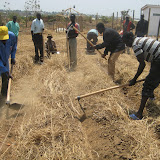
So the work is well underway in the village of Logo to prepare a ½ acre plot using the principles of conservation farming, known in 8 countries of Africa as Farming God's Way. Its exciting to see how the 19 farmers (9 members of Logo UMC and 10 of their village neighbors they invited) are working hard – and smart. They first cut a fire break around the plot, and back-burned it so that when (not if) the many fires that are set in the bush during the dry season reach the plot, it will not catch things on fire. Though there are not yet any crops to be damaged, and won't be until the March rains start, this fire break is still important since this method of farming surrounds the carefully spaced planting pits (maize) and furrows (groundnuts, sweet potatoes) with a 4-inch blanket of dried grass mulch that would flare up instantly.
But the progress I see is not just the fire break and straight rows of holes and furrows and the 3-pile compost system. It's also the willingness to defy the typical community-NGO relationship, and not demand everything be provided by the NGO. It's the willingness to undertake a development project as a spiritual covenant with explicit commitment for each side to partner by providing labor, materials, and prayer. It's the willingness to negotiate changes in the agreement, by offering to cut poles for fence posts in order to save money to be spent instead on extra tools and rubber boots. All this is possible because the project is based on a relationship in which there is trust, communication and flexibility. Because he trusted me, Pastor Simon tried a 6 x 7 meter plot of maize with this method, and it produced more than his neighbors. Because they heard him describe his success and they trust him, the members of his church agreed to let him organize them into a group to do this on a larger scale. Now as Alex Lupayi takes what I taught him and teaches them, he's developing a relationship in which the Logo farmers trust his teaching and advice. I've told them, and they've started to repeat it back, that when we use their demonstration plot as a teaching site for other villages it will be an inspiration and blessing to others who will trust that these village farmers, just like them, tried these methods and they worked.
In their own Kakwa language, their village name Logo means Strong.
Thursday, September 8, 2011
How do we start eliminating poverty?
In August Diantha and I attended the Sudan Roundtable, held in Uganda, with 6 of our Sudanese colleagues (pastors, laypersons, women, youth) as well as representatives of every United Methodist interest doing substantial mission in Sudan: East Africa Annual Conference; UMCOR, Women's Division and others from GBGM; Ginghamsburg United Methodist Church. The idea was to listen to representatives of the Sudanese United Methodist Church speak of their priorities, and talk about how we might increase our coordination and cooperation to meet these needs. A new District Advisory Committee set up by the new District Superintendent Fred Dearing had after much discussion and discernment settled on Eliminating Poverty and Reducing Killer Diseases as their first and second priorities, respectively. After two intense days of discussion in Uganda, we hope and pray that the resulting work by all the partners in mission in Sudan will continue to act on these priorities. As we reflected on them ourselves out of our one short year of experience on the ground here (and several years of work in these areas in the US) we came up with suggestions for principles that might guide the work of eliminating poverty, and that we are trying to practice:
1. Support projects that work with people, not just for people. We are currently using the church/village planning approach: the church/village picks the project area, the District sets budget limits within funding available, village and District work together to make the project fit budget. Building the capacity of the local church/village to manage their own development is more important than any concrete outcome: strengthening the experience of owning the process, learning to approach a big task/far goal step by step, learning to realize and bring their own assets into the project (materials, labor) so that the process is genuinely a partnership between the church/village and the District, and becomes culturally sustainable with local leadership beyond our involvement. Pastors appreciate being clear and consistent about following Biblical principles for the way the outside resource-provider assists the church/village for the up-building of all the UM churches in South Sudan. These include:
i. Equality (Acts 2:44-45) no one has too little or too much, and
ii. Accountability (Matthew 25:14-29) what have you done with what was given?
Diantha and I continue to practice these principles as we hold churches accountable to the changes they have made in their project plans, especially when that means they run short of money! We gently remind them as we have from the beginning that we have the same amount of money to help each church (thank you, Holston Conference!) and that if they change the project from the plan and budget agreed upon, they need to also take responsibility to find the resources to finish the project.
iii. Participation (Mark 6:35-44) start with what you have, even if it is small. We have been gratified to find how willing the church members and village neighbors have been to raise more money, to dig latrine holes, to make bricks and build school shelters, and find a variety of ways to contribute their part to the project benefiting their church and village.
iv. Planning (Luke 14:28-30) count the cost before starting. One or two churches have led the way by planning ahead and saving some of their harvest to provide seed for the next season; we have copied their example in providing all the churches with seeds on the condition they make a commitment to do the same thing, as well as planning to use some of the harvest also to help the needs of widows and orphans that are in each church.
2. Increase wealth by building on the asset base: this means that the main emphasis for the Sudan District UMC is on sustainable agricultural development which multiplies amount of crops that can be grown in a given area and in a given time by using improved methods of conservation farming while still using hand tools and homemade inputs rather than purchased fertilizer, pesticide, etc. Recently we have given each church a moringa tree and several papaya trees after the pastors attended a workshop teaching them the nutritional benefits of moringa and the medicinal benefits of papaya.
3. Improve the capacity to manage, not just increase, wealth. Projects eventually must be financially sustainable beyond our involvement. Our Microenterprise Program (PUMMP) teaches this to pastors and church leaders; we just graduated the first class of 6 pastors and gave them loans. Pastor Faustino of Ligitolo said, “This is the training we have been needing to improve ourselves!” Now we have started training a second group of 9 pastors in business management, this time in the local language (Kakwa), and we plan to hold training for churches on managing projects; to seek funding for a village savings bank program that includes financial management; and to develop workshop on managing personal finances for pastors, women, youth and other church leaders.
4. Start now developing leaders who can take over the work. One way to do this is to strengthen local leaders to get out of poverty themselves so that they can help others to do so, beginning with pastors, who receive little to no salary. Local people are increasing their ability to manage church/village planning (Pastor Isaac Sebit), manage the Eden Teaching Farm (Alex Lupayi), and manage the PUMMP training and the personal financial management training (Joice Jaka). With the help of short-term volunteer Thomas Sherbakoff, we trained 3 key church leaders in Basic Fund Accounting so they can handle the larger amounts of funds coming in to various District programs.
5. Make training a priority over equipment/materials. Many NGOs and mission efforts in the past have provided tractors and other pieces of equipment that are now lying unused, broken or rusting because of problems such as: Who can repair it? Where do you get replacement parts and how do you afford them? Who can afford the fuel? Other problems include disputes over ownership and management of the equipment. In our Basic Farming Methods training for 31 village farmers we gave hoes, machetes, and seeds only after they completed training; the pastors received a Moringa tree seedling only after attending the Moringa training. Diantha just coordinated a training for Traditional Birth Attendants that significantly increased the skills of 46 village women, who then receive 10 UMCOR birth kits each to carry out their new knowledge. We are hoping to get funding for a program to build the capacity of United Methodist Women groups so they can develop the capacity to handle income-generating pieces of equipment.
6. Look for and use collaboration wherever possible and appropriate. Many more people can be helped with many more services, resources and knowledge to reduce poverty by cooperating with other mission groups and NGOs. So, we have started monthly roundtables of other NGOs and mission groups working in agriculture, and in health. Christian Reformed World Relief Committee has provided free training and materials for workshops on maize, cassava, and sweet potatoes for 130 farmers in 2 UM churches. UMCOR is planning for UM churches to benefit from their projects in fish farming, poultry raising, cassava growing, beekeeping, renovating a remote primary health care unit, and community health outreach. We are providing UMCOR with business training for 220 farmers.
7. Seek sustainability to make poverty reduction permanent. Besides cultural and financial sustainability, environmental sustainability is key so the land remains an asset producing wealth. I had resigned myself to a gradual, difficult process of persuading people that this is a long-range investment that may not show results now, but will in the future. So it was wonderful to receive this letter from the pastor of Logo United Methodist Church, after he actually applied the no-till/mulch method I taught the pastors, to growing maize (corn) on a small experimental plot near his home: “We are very happy for what you taught us about agriculture. The maize seeds which you gave us 198 seeds for 99 holes give us three buckets which is dry now. Next year we want to arrange ourselves in a group. Let God give you more ideas for helping us. Thanks, yours in Christ, Rev. Simon Duku”
Thursday, July 21, 2011
A New Sudan
1. Independence Day in the New Sudan
The night before Independence Day, our new District Superintendent Fred Dearing received passes for us to sit in the bleachers to watch the official birth of the Republic of South Sudan. I was amazed at the diversity of the crowd gathered in Yei's Freedom Square to celebrate their first Independence day. It included not only the many Christian denominations that are here, but also local Muslims; not just South Sudanese from almost every state, but even Darfuris who sincerely celebrated the independence of their Southern brothers and sisters even while their home area in the western part of the North continues to suffer massacres of entire villages. It was great to witness that in the midst of their own celebration, South Sudanese pledged continued efforts for peace and freedom in Darfur. All the more amazing to realize that Independence is not just decades but centuries overdue for South Sudanese, who have been controlled, exploited and oppressed by others since ancient times without cease. In a sea of hundreds of banners, one summed it up in the words of Dr. Martin Luther King: “Free At Last.” People had walked to Yei from surrounding villages; some climbed trees to join the thousands enjoying marching and speeches in Yei's Freedom Square. Every local civic group and school had a banner and marched in a long parade; Salaam United Methodist School was there marching in their school uniforms. Sudanese women groups marched with banners proclaiming their commitment to playing a key role in the development of the new South Sudan. As we looked around us in the bleachers, we saw Sudanese young educated professionals listening intently to all the speeches, responding at times to commit themselves to the task of building a new nation. The highlight of the day was the simple act of lowering the flag of Sudan, and raising the new flag of the Republic of South Sudan. People cheered and ululated wildly, and that energy continued into the afternoon as dozens of tribal groups gathered in circles around Freedom Square into the evening to dance traditional tribal dances: Kakwa, Nuer, Dinka, Mandari, and many more. I hope and pray the peaceful, joyful spirit of those co-existing celebrations on Independence Day can be continued permanently into the complex process of becoming one nation of many tribes working together.
2.Oil and Food in the New Sudan
Petrol (gasoline) prices in Yei have risen to about $6.80 per gallon, but farther north in Unity State they are over $10 per gallon, down from $12 per gallon during the height of the fuel shortage a few weeks ago. Even though 75% of the known oil is located in South Sudan, all the pipelines and processing are in the north, and the north stopped allowing shipments of oil after the vote to separate. Oil from other countries has slowed down, reportedly because Libyan oil production has been disrupted. South Sudan is working on arrangements to build a pipeline through Kenya to a seaport, but that is expected to take 8 years. Meanwhile, higher fuel prices mean higher food costs (over half the local food is still imported and trucked in.) Already food prices were rising independently of this crisis; according to the South Sudan Minister of Agriculture Anne Itto, maize (corn) prices in Kenya rose 130% in the first half of 2011. Adding to that the fuel crisis in South Sudan, Itto says maize prices have quadrupled here (Sudan Tribune 16 July 2011). The conservation farming methods we're teaching here are increasing yields by 6.5 times in Zimbabwe just using existing hand tools with no commercial fertilizers (Conservation Farming in Zimbabwe: Evaluation Report, January 2011, Canadian Food Grains Bank.) If we can show that these methods do even half as well in South Sudan, it could help increase food production here quickly and inexpensively.
3. Training Leaders for the New Sudan
Elizabeth Heft, an Individual Volunteer in Mission from Ginghamsburg UMC in Ohio, is here for 6 weeks as an Individual Volunteer in Mission conducting training for youth leaders of the 17 United Methodist churches in South Sudan. It was exciting to see 35 Sudanese young adults, about 1/3 women, gathered for the 2-day retreat here in Yei. Elizabeth and Peter Lomorro, the Youth Coordinator for Sudan District, did a fantastic job of providing much appreciated training while the young adults provided joyful worship with drums, shakers, song and dance...and fervent commitments to the task of leading and teaching youth in the remote village churches. Looking over this group of energized young women and men gathered in Yei UMC as we celebrated communion on the final day of the retreat, I was moved with the knowledge that faith development among the youth of the village churches would take a major step forward, and astounded to realize that several of these young adults would be, in a few years, pastors of these and of new churches. What an incredible gift!
Wednesday, May 11, 2011
Mission in South Sudan: May 11, 2011
Hankins Leave Sudan
There were tears, prayers, singing and heartfelt thanks as Boo and Phyllis Hankins met one last time with the United Methodist pastors in Sudan District. After two years of mission service in Sudan Boo and Phyllis Hankins are leaving Sudan, to return to serve churches in Tennessee at the request of Bishop Swanson of Holston Conference. In fact, they left 3 days ago after preparing Diantha and I to respond to interim tasks such as unexpected medical needs of pastors and the ongoing support of several orphans and sponsored students. The Sudanese pastors thanked them for strengthening the churches and teaching them English and more. Their fellow missionaries thanked them for their example of teamwork and endurance as they persevered resolving crises in church and school. Diantha and I are grateful that God used them to do the difficult pioneering work in the development of the church here, work that not many others we know would be able or willing to do. Twenty-two years of the traumas of war and refugee camps leave deep wounds in peoples' hearts; in the case of the Sudanese United Methodists, these wounds have been exacerbated by the corrupt behavior of several former local church leaders which has deepened a prevailing sense of mistrust. The Hankins have worked step by step with these church members to build stability, continuity, and a sense of being part of a much large connection that will not let them be the victims of the whims of individuals any more.
Women's Division Team Visits Sudan
Two staff (Marva Usher-Kerr, Carol Van Gorp) and a Board member (Ollie Pleggenkuhle) of the Women's Division of the General Board visited South Sudan in April. They held a workshop for the United Methodist Women leaders to help them develop come together as a district, and develop some goals. In preparation for their visit, Diantha researched the existing programs for women's literacy in South Sudan, and the effectiveness of different approaches. We are hoping for their continued support of agricultural training for women, and continue to explore with them a possible approach to increasing the literacy of women, and of beginning village micro-finance programs that would put management of credit in the hands of trained village committees controlled by women.
Reducing Poverty: Our thinking advances...
For 9 months we have been thinking day and night about the issues of poverty we see daily: hunger, lack of money to pay for school fees or medicines. We can see now how the pieces might fit together to allow people to improve their life situations: now they have little income, so there are always more demands and urgent needs and their culture encourages them to help others rather than saving. If we could help them start micro-finance programs, in the future it would allow people to add up small savings in a village "bank" that they manage collectively, and learn to manage their money, which could be used to start income-generating activities or to pay for household needs such as school fees and medicines. There's another key piece of the puzzle: they need to improve their income, which in rural South Sudan mainly means improving agricultural yields and income so they can grow enough for their families, and have some left over to sell. Yet another piece: health is important. If they learn to improve their health and even to grow some of the medicinal plants they need, they are strong enough to contribute to the family income; but if they are sick, they deplete the family income.
Collaboration Blossoms
"How very good and pleasant it is when kindred live together in unity!" (Ps. 133:1) From the time we got here, we've tried to get to know the other groups and people at work in South Sudan, especially in health, agriculture, education and micro-finance. The result last fall was that Diantha was invited by an NGO to help create a manual for training community health workers, and I was asked to be part of interdenominational trainings for pastors youth. At our request, another mission group provided our UM nursery schools with digital players with a variety of teacher training lessons on them. In March we contracted with a Christian Reformed group to provide training for 31 farmers from United Methodist churches. We were concerned that there was no regular gatherings of people doing similar work, to share progress and consider working together; so Diantha and I played a key role in starting monthly informal "teas" around agriculture and another around health. Since then the cooperative work has exploded: the same Christian Reformed group has offered to train for free, two groups of 50 farmers on improved cassava and sweet potatoes from two different villages where there are UM churches; UMCOR is working with us to select one of our remote UM churches for a fish-farming project and is trying to set up a health project so that it benefits another of more remote villages where there is a UM church. While our budget is tiny compared to the other mission and NGO groups here, or perhaps partly because of it, a lot is happening to help the villages we focus on, because of the growing willingness to collaborate.
Saturday, April 2, 2011
Mission in South Sudan: April 1, 2011
Farming God's Way (FGW) Moves Forward
Small steps forward for this method of conservation agriculture in which soil fertility and scarce water is kept and increased both by not plowing and by covering the ground with a layer of mulch; and by adding natural fertilizers like composted grass and manure. FGW incorporates principles from observing Creation and from the Bible that works well to teach these methods in the villages of south Sudan. I held a workshop February 16 for 19 UM pastors and assistant pastors (I expected 10!) to introduce them to FGW; as a result, so far two pastors (from Logo and Mirodu villages) reporting to me that they have prepared a sample plot using these methods and are ready for me to supply them with maize (corn) seed so they can try it out! This makes me very happy. As of today I am proud to announce that Eden Teaching Farm of the Sudan District has officially begun what the new UN report on agroecology (conservation agriculture) calls "decentralized participatory research."
Not only that, but these methods may help Darfur in the north of Sudan. I've had a couple detailed email exchanges with a colleague in Darfur who hopes to use these methods there, and have tried to help her figure out how to adapt the the FGW methods to that area which has drier climate and scarcer resources than we in the south. I'm eager to see what may work there.
Steps forward on the global scene too: I've just discovered a new UN report (December 2010) advocating strongly for increasing the practice and scale of agroecology to increase food security and help small farmers worldwide; and a decision by the Food and Agriculture Organization (FAO) of the U.N. in June 2010 to promote this "integrated holistic approach" for sustainable crop intensification. They even mention the importance of "learning by doing" and of partnering with non-governmental groups at the local level. So far the farming methods we are beginning here is not yet widely accepted or practiced in Sudan, but this tells me it will be promoted more and more. I'm encouraged in my work and thankful to be helping the villages and churches we work with to be involved at the beginning of an important movement.
Steps Forward in Development Hearts and Minds, too
We (mostly Diantha due to my limited mobility on motorcycles) have now completed basic strategic planning meetings in 13out of 17 villages, a process we began last September. We had no idea it would take so long! But we're excited by what's happening. We invite each church to choose an initial project that must meet 4 criteria: (1) It must address a top priority identified by the village during the planning meeting (2) It must involve investment by the village of labor, materials, or both (3) It must require no more than US $150 from us (4) It must be able to be started soon and completed in 4 months or less, so that the church and village have an immediate sense of succeeding in the long path to development. The results are interesting: Three churches have chosen an initial project in agricultural training because they reason that increased production will mean they have more food not only to eat but to sell to get money for school fees, medicines, and other crucial needs. Seven churches have chosen to build an additional school "building" (simply a thatched roof) so they can move more classes from under the trees and expand the number of village children who can be educated (for many of these children the church school is their only option as they cannot afford the higher fees of the government schools, which also may be too far away to walk to). And one church has chosen to build latrines so that their school children can improve their health. One church wants help to get culverts in the road to make it passable in the rainy season and allow their children to walk to school even in the rainy season. The reasoning behind their choices are gratifying. So are, increasingly, the comments made during the planning process. We always ask early on in the meeting for a list of things people are thankful for, as well as (inevitably) a list of what they need. During the first planning meetings last fall, the lists were predictable: they were thankful for their church and the local school the church had begun, the seeds and tools they have been given, the bore hole (deep well) dug with funds from US churches. But since the Referendum in January, the list of thanksgivings have been changing and deepening. We hear thanks for the Referendum, thanks for freedom and peace; and we often hear thanks for the improved life of women. Women are thankful for liberation from the fear that a harsh version of sharia (islamic) law could be imposed on them; thankful that the new government is making a commitment to the rights of women including making women 50% of all government leaders; thankful for a focus on decreasing gender based violence. While the villages and the churches, like the towns and the government, still have a long way to go to put all these changes into practice, its great to hear the excitement and hope in these comments. We feel privileged to be here, doing this, at this time.
Sunday, February 20, 2011
Mission in South Sudan February 20 2011
Apologies (Steve)
Sorry we've been gone from our blog for so long. It's not just that a lot has been happening, its also that we blog into space and don't get much sense of whether people are reading it. But in the last months several folks wrote us quite concerned that we haven't blogged and wondering how things are, how we are. So we're learning that this mostly one-way conversation in which we do the talking is the way blogs are. Sorry, we're new to this, and we'll try to do better.
Steve's Mom (Steve)
By the time I arrived in Pleasant Hill, Tennessee, my mother (Peg) was out of the hospital and making steady progress in being better hydrated and in alertness. Diantha and I took our turn after my sister Merri and brother Dan had done the same, in going to the nursing home daily for two weeks and helping feed Mom her pureed diet and nutritional supplement, spoonful by spoonful, about a 90 minute process each meal. And we talked to her and sometime she talked back and a few times it made sense; we hugged her, sang to her, joked with her. On the morning of the 11th day there, as I turned from Mom to greet one of the other nursing home residents, she looked at me and called my name for the first time. Later that afternoon, as I sat holding her hand, she said "I love you." and pulled my hand to her mouth and kissed it. Then I was absolutely sure the whole trip was worth it.
Short-term Mission Team from Holston (Diantha)
We had a busy but successful time with a team here; they got here 3 days after we returned from our trip to the U.S. to see Steve's mom, and stayed for 10 days. They started working in the new demonstration plot next to the District Office, now called Eden Teaching Farm (for demonstrating and teaching agriculture and health practices). There were 6 Sudanese teachers from our UM-related nursery schools who were on break, who came and help make demonstration plots and build the posts for the latrine structure. Now we need to finish the wattle and daub walls and thatch the roof. That was a big project, as I had wanted to use an adapted design from Zimbabwe, and use Sudan's mud hut style, plus the pit was dug bigger than I had told the people the dig. So there was a lot to learn and figure out on my part, but it all worked out well!! We shall see how effective and desirable the design is. We also had chance to take breaks from working in the heat and do short educational pieces, about the Farming God's Way method that Steve was using to design the plots, and sanitation education they could replicate at home. Two or three members of the Holston team joined us, so it was good to get to know them, too. We had fun with the teachers, and they had great fellowship with the U.S. team members.
One of the Sudanese teachers who worked with us, Amule, was from Ridya, one of the poorer, more remote areas. They are still trying to locate a good place to drill their bore hole, so they don't have the health advantage of clean water. Amule had a resurgence of his malaria the first night of our 4 day training, but I had some medicine on hand to give him. If he had been home in Ridya, he probably could not have gotten any medicine. He broke out in fever, sweat, chills, body ache, and was stumbling around. Also he had not made any arrangements to stay over night. We sent him to Yei UMC where his pastor and others were in pastors training, and church members found a place for him to sleep. I had expected him to be quite sick, so was thankful and surprised when he showed up the next day. He managed to work (and take some breaks; people here work in the heat when they are sick. It's amazing), and was a good bit better by the time he went home. Also, he showed me these deep painful cracks in his feet from walking barefoot so much. I gave him some of the salve I made at home and Vaseline jelly. He had flip flops, and no other shoes, and would have to farm barefoot. Cracks like that also need shoes to heal. Another member of the team had rubber boots here that fit him, and someone donated socks, which we gave him. I usually feel uncomfortable giving individual people a lot of things, but this seemed totally fitting, and would impact his life. I think it makes a difference when you have a relationship with the person you are giving something to. Amule also earned a week's laborer's wage by helping with the plots, and like the other teachers he got a certificate (which people really cherish) and materials to make a tippy tap handwashing station. We all wish him and the others well.
Referendum Results and a Tale of Two Bullets (Steve)
On February 7, the day the results of the Referendum were announced, the short-term team from Holston was still here. At about 8:50 pm it must have been announced on local radio stations that President Omar Al-Bashir had accepted the results of the Referendum that 99% of the voters in South Sudan had chosen separation from the north. Immediately cheering broke out in neighborhoods on all sides around the UMCOR compound where we stay, and within 5 minutes we heard repeated gunshots as well. The two UMCOR guards on duty, one who had served as a guard to John Garang, the former leader of the southern rebel army, came quickly to our guest apartment to reassure us that the gunshots were celebratory and we had nothing to fear. "It is an end to war! It is the beginning of peace!" they told us. They were very excited. I suggested we pray to inaugurate this new era, and with Diantha the four of us held hands and prayed that God would lead and bless the new South Sudan. The cheering, and celebratory shooting into the air, went on for another six hours without stopping.
Four days earlier I had found a bullet. Or more exactly, one of the Sudanese teachers helping prepare a farm plot had unearthed an old rusty solid iron bullet about 2.5 inches long; the older teachers and compound guards told us that this was a bullet of the northern army that had overrun Yei at one point, a memento of the 40 years of war that had ravaged South Sudan. We celebrated that what had been a field of war, was now becoming a field of peace where people would learn how to grow more food and live healthier lives with less disease. Then the day after the February 7 spontaneous celebration of the Referendum results, I found a shell casing in the yard in front of our house from someone's jubilant shot into the air. I keep the two bullets, the bullet of war and the bullet of peace, on my desk beside my computer as I write.
Monday, January 3, 2011
My mother, Peg Hodges has been in and out of the hospital in Crossville Tennessee this last week because of severe dehydration. She stopped eating and drinking while at the nursing home in Pleasant Hill, and by God's grace my sister Merri was there. After talking by phone with my brother Dan and via Skype with me, Merri got Mom admitted to the Crossville Hospital. She was unresponsive for a while. But once she was hydrated by IV, she gained responsiveness, her sodium levels are back down to near normal, and she is back in the nursing home as of Friday! We are thankful to God!
The doctors at Crossville Medical Center did tell my sister that Mom has entered the end stage of Alzheimers, and that her ability to eat and drink -- and therefore her health -- will continue to be fragile. My sister left Sunday, and my brother arrived Saturday to take over from her and to be with Mom for a while. In the midst of the crisis last week Diantha and I spent some time in discernment, and decided to fly back the the U.S.; we'll arrive Jan. 5 and stay two weeks, taking our turn being with Mom and trying to get her to eat and drink. We'll stay with Diantha's parents who also live in Pleasant Hill. Folks that want to reach us can get us at 931-277-5951 or shodgesjubilee@yahoo.com.
Pray for Sudan and the Referendum; and pray for my mother, Peg Hodges.
Love, and Happy New Year,
Steve
Christmas Reflections
It is good to hear even short messages from family and friends, and we have heard from many at Christmas. We are having a nice break, as there is less business activity here during the holidays. Local people who had family out of town, and had money have gone to visit. A number of other missionaries are away for Christmas and the referendum for independence (for the week beginning Jan . 9). It is great to take a break, and catch up on some things at home. We are in the dry season, which is a bit hotter and much more dusty. But yesterday there was some rain, and a bit cooler temperature.
We had a wonderful and meaningful time around Christmas, and keeping busy also helped not feeling lonely. We connected with people over the internet (emails and skypes with family) as well as many folks here, through church and missionary fellowship. We were able to celebrate Jesus birth and the love and gifts we have through other people. We had three gatherings with other missionaries, with international Christmas treats, singing, fellowship and children. We found some carols and music on the internet, and played some of the CD's we brought. We attended Christmas day and Dec 26 Christmas services at church. People were extremely joyful. There was lots of singing the favorite songs, lots of jumping and dancing, and people hollering. There were at least 100 children at Christmas (40 in the childrens choir, which is it's max) plus lots of adults, to fill the church. Many children received new clothes for Christmas. Some had plastic sunglasses, and beads in their hair. One of the women in the church invited several people from church to dinner at her house after services. She served us in her grass thatched mud hut (about 12x12 feet), which was considerably cooler than the heat of the compound. She had covered the ceiling and walls with beautiful cloths, brought a small table and a few chairs inside. She served us some fried bread/biscuits and juice first, then brought their typical foods, fried chicken, boiled eggs, stewed chicken in broth, beef stew with lots of cabbage, cabbage and tomato salad, rice and posho (boiled corn flour, like a thick mush). We usually don't have so much variety in one meal!
We were able to do some small extra things for a few people near us. The guards at the compound where we stay had asked Steve for some gospel music a while back. He made a CD from some different CDs we brought with us. Also, Phyllis Hankins and Diantha visited one of the leaders in the church, Edina, and took more gifts for her twin babies: diapers and a front carrier. We have a policy not to give a lot of handouts as many people ask for many things and we are trying to break the stereotype of white people coming here to give lots of handouts. Also, through our work we are emphasizing how we can work together to help provide needs people have in the villages. It was nice to find some ways to give some simple gifts.
Diantha and Phyllis have continued to help various people with medical concerns. One was one of the women leaders who attends the church in Yei. We were told she was very sick, and a number of church members were at her house visiting. She was no longer able to get up, not eating much and was in a lot of pain. Her whole face was very swollen. They had taken her to two different clinics in the past one and half weeks, each with different diagnoses, and she was still getting worse. Some of the family was advocating to take her to the witch doctor. Once Diantha saw her, she knew enough to realize she was misdiagnosed, and need help right away. Phyllis was able to drive the vehicle close enough to load her in the car. Phyllis was also able to pay the registration fee. We took her to a different clinic, which has good equipment and doctors, and beds for overnights. It turned out to be a bad tooth infection. She is now back home and recovering. Diantha thinks in this, and other similar situations, she is able to judge the conditions enough and help people get the medical care they need. By the time some people go for care, their situations are in a state of advanced need. We are both thankful these interventions are possible and helpful, and this woman did not have to die from a tooth infection.
We have heard people partying in the nearby residences most of the night for several nights. There was somewhat of a repeat over New Year's. The referendum should be quite exciting. On Christmas day, Freedom Square, which is the town square was packed. We heard there was music and traditional dancing. We've heard they have scheduled different pastors and churches to be present until the referendum to pray and preach every day.
God is good to us and our new Sudanese friends and neighbors!!
Monday, December 13, 2010
Mission in Africa, Advent Dec. 13
Our early "Christmas" with pastors
The last regular pastor's meeting was also our last meeting before Christmas. Phyllis Hankins has been teaching English classes to the pastors weekly, and as it was an end of the semester, she handed out simple prizes (mostly pencils, rulers, some crayons in little baggies), for those who had the best attendance, the top three scores, and the most improved. The most improved was Mama Helena, an older evangelist who is pastoring a church, who has not had the opportunity for education before in her life. She has learned to hold a pencil and to write and to speak a bit. She said now she is proud to know the letters and can even say the letter "U". I have often helped her with her homework, which she finds quite difficult. She is the one who gave her African shout for Phyllis and I when we said we were now the drivers in our families, due to the injuries of Steve and Boo. When she got her award, I jumped up and shouted as best as I could and gave her a big hug. She was extra tickled. All the pastors were SO pleased to receive these simple things; their eyes shone. One special moment was watching them examine the rubber bands. The two women ended up taking the ones of the brightest colors and using them as bracelets.
Phyllis also handed out, grab bag style, one article each of used clothes donated by visiting teams. It was also the time to give out the Christmas monetary donations to each pastor from Holston Conference. After all these gifts, and the obvious gratitude of the pastors, I stood and led a common expression of appreciation as we sometimes do in groups by all clapping together in a certain rhythmic clap. One pastor then stood and expressed thanks for these gifts, saying it is more than his mother, father, brother or sister can give him. The rest of the session turned into my Christmas; this became a spontaneous event, Sudanese style. Time was given for everyone who wanted to, to stand and say what was on their mind. One after one stood and expressed thanks. Several gave prayers. They are thankful for the English lessons they have had. Several mentioned (first was Mama Helena) that before they could not even speak much in front of others, and now they are speaking more, and some are able to speak to other people in English. They expressed appreciation to Holston Conference, for the water, and other things. They expressed that these gifts also tell then how much God also loves them. They appreciate the missionaries who have left home and family to "come suffer with us in Sudan". This was a real celebration. (we have had other sessions like this but with needs expressed). Steve shared that although we have left family and home to come here, we are humbled by the pastor's constant sacrifice by serving with little or no pay; that in itself is a gift to us. My "Christmas" this day was being in the midst of sharing, gifts (small but meaningful), thanks and celebration. God's love (and Christmas) can be shared in small but meaningful ways. Here, cultural reminders of the Christmas season are not all around us. The Churches don't celebrate advent. Christmas decorations and trappings feel out of place in the heat and tropics, as I am from a northern climate. Christmas presents even feel out of place. But small reminders of the grand generosity and love of God do seem very appropriate, and this is what I will remember as I find ways to celebrate this year.
Diantha
Tuesday, December 7, 2010
Mission in Africa - December 7
Village Visits
After much preparation, in November we have started going to the United Methodist Church in each village to have an all day planning session with all the local chiefs, leaders and people. Pastor Isaac Sebit rides his motorcycle and we ride ours, since the Hankins need to use their Landcruiser every day. Most of the rural roads are treacherous with ruts, mud holes and sandy spots, so we fall off the motorcycle now and then (at very low speeds with no serious injuries.) Usually Steve drives; but there is about 10 miles of the dirt road northeast of Yei that has been smoothed and hard-packed this year, and Diantha drove that stretch last Friday, her first trip driving the cycle. We switched drivers when it was time to go off the main road, and spent one hour going down a grassy lane, with mudholes and potholes, etc. Hard going, two falls despite new mud tires, but the meeting after we got there was very good. At the beginning of the planning meeting, Steve reminded folks of Jesus' teaching that if we have faith even the size of tiny mustard seeds (we held up sesame seeds), we can move the mountains represented by their huge problems. He also reminded them of the story of Jesus' feeding the 5,000 as a reminder that though the people may feel they have few resources in the face of the big task ahead, God wants us to make the commitment of offering it. Diantha had brought 5 small loaves and two dried fish, and gave them to some of the children to bring up front; of course the children started sharing it among themselves and eating before their part, but that's ok; the adults applauded and laughed as the children held up what was left of the object lesson. By the end of the meetings with the first three villages, we are as excited with the process of getting people to take ownership and action as we are of the selection of projects. Each of the 2 churches so far chose getting training to improve their farming production, wisely concluding that this might not only help them feed their families better but also give them more cash to solve other problems including paying school fees and for medicines. We're arranging for them to be trained by another nonprofit group here that does excellent training, and will help them reproduce that training back in their villages for other farmers. Since we'll go through this village planning process with 17 churches, it will take some months, and it will be slowed by the registration and campaigning for the important Referendum to be held January 9-16 on whether south Sudan should be independent from the north.
Hurt Arm
On November 8 Diantha and I were traveling to Kirikwa, a remote village about 2 hours from Yei. We worked it out that Diantha should ride on the back of Pastor Isaac Sebit's motorcycle, because he is a much more experienced motorcycle driver than I, and we decided it was safer for her. I drove our motorcycle, which I had spent a scant 2 months learning on since we got it. About an hour into the trip as we dodged huge potholes in the road, I was necessarily going slowly, less than 6 mph, but steered too tightly around a pothole and the motorbike fell. I put out my right arm to catch myself as I fell, and my weight and that of the bike pushed the arm into my shoulder. My arm and shoulder hurt badly at first, but after about 5 minutes it subsided enough that I decided to get back on the cycle and drive another hour to Kirikwa II United Methodist Church. I was able to help Diantha facilitate a 4-hour planning meeting with Kirikwa I and Kirikwa II UMCs, eat a leisurely meal with the churches, then drive 2 hours back home to Yei. For about two weeks after the incident I kept thinking it was just a strain and bruised muscle, but after 2 weeks when I couldn't raise my right arm past my shoulder, I talked with a friend Sunday after missionary fellowship, Dr. Constance Rossow (German doctor) advised me to see her husband Dr. Matthias Rossow right away about my shoulder, so Monday I did. He diagnosed a partial rotator cuff rupture and urged me to get an MRI right away to determine whether just physical therapy, or surgery plus physical therapy would be needed. According to Dr. Matthias, surgery of this kind would have meant going to the U.S. After several days of preparation (mainly hounding the insurance companies to pre-authorize the MRI; Blue Cross did, UMVIM did not) Diantha and I flew to Kampala on Thursday and got the MRI the same day. I appreciate all the prayer, because it was very difficult -- but important -- to have my shoulder stuck in an extremely painful position for the 1 hour it took for the 48 exposures the MRI took. Friday we picked up the results and took them to Dr. Norberto Orwotho, the same very excellent orthopaedic surgeon that operated on Boo! The way all this timing worked out was indeed God's doing. Dr. Norbeto's assessment is that I do indeed have a partially ruptured tendon, but it is not bad enough to need surgery. Diantha and I are deeply grateful to God for that! And we got to attend a most amazing worship service with the Congolese refugee United Methodist Church in Kampala, and Diantha and I had time to relax, and celebrate our 36th wedding anniversary with some great restaurant food! Who knew there was fantastic Italian, and even passable Korean food in Uganda! I saw an excellent Physical Therapist in Kampala who gave me some good exercises and a list of things not to do. I am not doing the things I'm not supposed to do, and doing about half an hour of exercises three times a day, and already seeing improvement as the other muscles and tendons in my right arm gain the ability to compensate for the torn tendon. The main limit I face is not being able to drive either the motorcycle or the land cruiser for several months. It means Diantha and Phyllis have to do all the driving. And it makes it harder to figure out how to travel to the village churches, but we are determined to work that out so we can go to at least 2 or 3 every month and continue our work.
Some parts of dealing with injury have been surprisingly smooth for me: I got quick and excellent medical attention in Yei at a mission clinic, we were able to book an airplane flight to Uganda in a matter of days, the East Africa Annual Conference responded quickly with help by providing a driver in Uganda, the doctor and physical therapist in Uganda were extremely professional and helpful and gave me attention right away. But it is daunting to realize the distances to medical care that we had gotten used to having nearby: there is no ability to get certain tests, like an MRI, in south Sudan; and the closest physical therapist is a 5 hour drive away. The hardest part of the whole process was trying to communicate with insurance companies in the US who showed little flexibility to the difficulties of dealing with a health problem when overseas: the difficulty and prohibitive cost of communication by phone, the difficulty of finding a fax machine here, etc. And the most sobering part of the experience was reflecting on the reality that our Sudanese colleagues, pastors and lay people, have no access to the insurance and medical care that we are able to access. It was a powerful reminder of the enormous privilege we continue to carry as we live and work here. Readers can continue to pray for the Sudanese people who have so little access to medical help, and may consider making a contribution to the Sudan mission medical fund (at Holston Conference) toward the cost of medical expenses of Sudanese pastors, church leaders and their families.
Safety
Many of you have asked about our safety as news stories focus on the tensions, threats and scenarios of conflict leading up to the January 9 Referendum on separation or unity. Voter registration for the referendum began November 15 and will last two weeks. We have noticed more rallies, trainings of registrars, posters and also wake up every morning to the sound of the UN training Sudanese police to prepare for these events. We have some very knowledgeable friends who will keep us informed, especially if there is potential danger for us. We live on a compound with a fence and a guard, which is very near the UNHCR office, which monitors the situation and also keeps us informed. As we look at the situation, we think we are blessed to be in one of the safest places in south Sudan, with less crime and more calm than most places. We'll keep you posted as national events and our mission work develop, but meanwhile, pray for Sudan, for the referendum, for the Sudanese people, for the United Methodist churches, and for us and the others here working to help people.
Christmas
Seeing a Christmas tree in the hospital lobby in Kampala was the first reminder that it was two days before Advent. I realize how much I depend on cold weather and other cues to get me ready for Christmas. As we talk with mission and other expatriate colleagues here, we find that we are in a tiny minority staying in Yei for Christmas. We'll celebrate with a Christmas church service at Yei UMC, and probably a potluck Christmas dinner with Boo and Phyllis and a few other friends. We're all so busy we don't get to spend much time together. Meanwhile, we put Handel's Messiah on the the CD player, and look wistfully at snowy, cold emails and photos from friends.
Subscribe to:
Posts (Atom)