MISSION LETTER FROM STEVE AND DIANTHA HODGES, SOUTH SUDAN (Feb. 2013)
Dear Friends and Supporters: It's been a long time since we took the time to write to you about our mission work in South Sudan; much has been happening, as we describe below! And there's about to be an important change in Steve's status (though not Diantha's) so please read this newsletter to the end to find out.
DIANTHA'S WORK: SAVING LIVES AT BIRTH
Diantha's work has continued to focus on saving lives of both mothers and babies at birth, as South Sudan has the greatest numbers of deaths in the world. Many if not most women prefer to give birth at home alone. If they seek help outside the family, they call the local untrained Traditional Birth Attendant (TBA). A few go to government clinics scattered throughout the region. People have little understanding of the causes of complications or what to do; if they seek help it is sometimes too late, or distances/road conditions/costs too much. Our efforts are trying to change this situation!! We now have a team including Joice and Monica, two South Sudanese, and Dr. Lynn and Dr. Sharon Fogleman (who joined the United Methodist team last March).
We are focusing the ongoing training for the TBAs on life saving skills. In August volunteer Elizabeth Heft and her sister raised funds for training materials and the first equipment for the TBAs: fetascopes to listen to the baby's heart beat, (which is the same rate as their favorite praise song!!) and bulb syringes to suction the mucous out of the baby's mouth. They practiced their birth skills and how to stimulate the baby's breathing. The very next week we received the first of several reports: the baby was born and only began breathing after the TBA used the bulb syringe!! The TBAs are turning in birth reports to us, and receiving UMCOR's clean birth kits (helping to prevent deadly newborn tetanus). The TBAs gaining trust in their communities and turned to more often, as they have more training and new skills. We have received a praises from family members, and thanks from TBAs. One woman delivered the baby of a health department official, using her equipment and supplies. Now he is much more understanding of our work and supportive of training TBAs!!
NEW BIRTH MANUAL
All of the UMC churches are now using Diantha's newly printed training manual, “Learning Together About Safe and Healthy Birth” to hold their own classes several times a month in their communities. The manual is written in their local language and addresses key issues in an effort to save more lives. Some harmful cultural practices are addressed (such as putting dung on the baby's cord, which can cause the baby to die from tetanus). Child spacing is discussed so women don't suffer from the problems of having too many babies close together. Fathers also need to understand their role to help provide food, and allow her to avoid heavy labor and not prevent her from seeking health care. The classes which are held in the churches are the best way to bring the issues to everyone's attention to learn and discuss. This is the way cultural practices can be changed! Those mothers who have been to the clinic for prenatal care are given infant clothes (UMCOR layette kits).The response has been wonderful. We immediately began receiving reports of weekly classes with 20 pregnant women attending plus additional community members.
Next steps: Our next training will focus on saving the mothers, by controlling bleeding after the birth. We will be working to strengthen the connection to the rural government health clinics and to build an organization led by the TBAs that can be ongoing beyond the help of the missionaries. We have about 65 TBAs who have been coming regularly to our trainings, and new ones wanting to join at each training!! The Episcopal Church of S Sudan has raised some donations so we can also train some TBAs among their churches!
PROGRESS IN OTHER HEALTH PROGRAMS:
Drs. Lynn and Sharon Fogleman are taking major responsibility in heading up a 6 month HIV/AIDS awareness project in our churches (with South Sudanese managers and trainers, from Holston Conference HIV/AIDS grant), educating about malaria and distributing mosquito nets, starting a Community Health Evangelism project in one church (3-5 year program), and helping the Yei hospital with a new center for people with severe malnutrition. We have a new South Sudan District Health Board organized through UMCOR as an avenue with local ownership to be able to use Imagine No Malaria funds not only to fight malaria, but also other killer diseases.
The health projects in the UMC churches need ongoing financial support through the Sudan HEAL Advance Special.
STEVE'S WORK: CONSERVATION FARMING
Steve and Libby Dearing, with the help of Alex Lupayi and 2 pastors, monitored the 256 farmers in 18 villages we had trained in Farming God's Way (conservation farming.) We were pleased that about 110 of them (43%) practiced the methods throughout the long rainy season, a larger percentage than most trainings done here. After evaluating the short rainy season too, we have targeted several village UMC churches where the people have successfully applied the principles we have already taught them, in order to move away from continued dependence on us. In these village churches we want to do refresher trainings; one is ready for a new pilot project in nutrition garden; and one or two might be ready by August to pilot a project in using a simple chisel plow (just makes a furrow) to try mechanizing larger plots but still keeping to the principles of conservation farming (not turning over soil, keeping the soil covered with mulch, etc.) Steve and Libby hope that 2 or 3 village plots might be good enough examples that there can be Field Days in July to bring farmers from other villages to see the successful results of faithfully following the methods. We have been splitting the cost of these efforts using funds from the South Sudan REAP Advance (Renewing Environment and Agriculture for People) and Seeds for Sprouts.
WOMEN'S LITERACY AND SMALL BUSINESS TRAINING:
When Steve and (his South Sudanese assistant) Joice Jaka began offering the same training in small business record-keeping and management to women in the UM churches that we offered to 34 pastors and assistant pastors, we discovered over 3/4 of the women could not read, write or use numbers, (as they had been denied education because of the war, poverty and culture which prefers to educate men) . So far we have trained 130 women from 15 churches in numeracy and small business and helped the women form group businesses with a business plan and small loan (for projects such as growing and selling vegetables, or reselling dried beans). Several of these group businesses are already paying back their loan, and as they successfully accomplish their business plan as a group and pay off their loan they will be eligible for a larger loan and bigger business project. We hope they continue to grow in their capacity for business and for functioning as a group, to take on larger and larger projects. Under Joice's supervision, Monica Ajonye is currently training 30 more women from 4 churches on the Congo Road, and plan to reach the final 3 churches in Lainya County by July. Six pastors have come back for second loans after successfully paying off their first loan.
NEW PROJECT: VILLAGE SAVINGS AND LOAN ASSOCIATION
Steve and Joice have also started training the first UMC Village Savings and Loan Association at Ligitolo UMC (though it includes many of their village neighbors.) We are using a great model developed by World Vision that raises the loan capital from the people themselves, who also elect their own officers and make all the decisions about the savings and loan association. We are able to do this thanks to funding from the Sudan COME (Congregations Organized for Microfinance Empowerment) Advance. Now all three elements of reducing poverty have been started in our UM mission work: increasing income, improving the management of income, and saving income/creating wealth. Having conservation farming underway as the primary method for people to increase income (it multiplies maize yields by 3-4 times), and training in record-keeping as a method for people to manage this income better, now the village savings project will provide the ability to save some of this income for school and medical costs and larger business projects.
BIG CHANGE IN STEVE'S STATUS:
You may have noticed that in all the work Steve does, he has colleagues doing a great deal of the work. From the beginning he has had the goal of gradually turning his work over to others in a way that the work can be sustained without him. With God's help, the work has progressed to the point that this is the year it can be turned over, though with Steve close enough to be consulted when needed . The work will be carried on by others, and still receive funding from the COME and REAP Advance Specials. Meanwhile, he feels the next step in responding to God's call to mission is to establish a way of helping farmers increase success, and to do this as a project not dependent in the long run on donor or grant funds but with long-term financial sustainability. In other words, establishing a business with a social cause: reducing the risks of farming so that farmers can grow their income. Steve is starting a business in agricultural risk assessment and management; having to survive in the marketplace means it will have to be efficient and effective. There is already some demand for this business in South Sudan and Uganda. It also means Steve needs to end his official status as an Independent Volunteer in Mission (IVIM) with the UMC so there is no conflict of interest in running a business, though he plans to continue to being available on a volunteer basis to UMCOR and to respond as requested to those involved in the transition of his work with the South Sudan District UMC. To learn more, see www.africanagricultureriskmanagementservices.kbo.co.ke or email Steve.
WHAT THIS CHANGE MEANS FOR DIANTHA:
We have discovered that this change will be happening February 28. IVIM will close our joint account for donations, and begin a new account for Diantha alone. Though Steve's part of our living expenses will no longer be covered through the IVIM system, we are hoping that many churches and individuals will continue supporting Diantha through IVIM so that her living expenses can be covered as she continues to carry out her mission work as she has been. Beginning March 1 donations to IVIM must carry Diantha's name alone, of course in addition to the IVIM Advance number #982465, otherwise IVIM will have to contact the donors and request them to redesignate their donation. If donors do not want to support Diantha alone, we would encourage you to consider donating money to the Advance Special projects: Sudan REAP #3021296 for agriculture, Sudan COME #3021289 for microfinance and savings programs, Sudan HEAL #3021298 for health programs.
STAY IN TOUCH, PLEASE!
Thank you so much for your faithful prayers and support. Your prayers are part of what is helping us to keep moving forward and are especially needed for this period of transition. We also appreciate getting messages by email or Facebook from our supporters!! Contact Steve at shodgesjubilee@yahoo.com and Diantha at dianthah@yahoo.com or either one on Facebook.
In Christ, Steve and Diantha Hodges
Sunday, February 17, 2013

Tuesday, September 11, 2012
New farming, New literacy
August 2012:
So based on actual visits to farms by my three extension colleagues, 83 (30%) of the 275 people we've trained in faith-based conservation farming (Farming God's Way) have kept practicing the methods we taught them throughout this growing season; I had hoped for more. But there are some outstanding examples among those who have done it right, and even shown initiative and experimentation like Pastor Faustino who grew beans using our methods, and worked out a way to dig ditches to drain the too-much-rain from his maize (corn) and later when the days are too dry to stop up the ditches and fill them with sand so that they keep the water but don't breed mosquitos. I praise God for him and many others like him!
Farmers in northern Uganda taught me a lot during my August trip there about the ins and outs of adding value to agricultural products through grain and cassava milling, rice hulling, and pressing oil seeds. Bankers told me about new things they're doing to help farmers get the money they need to move into more profitable farming, like beekeeping. I'm trying to figure out how to apply what I learned in South Sudan, and am hoping to learn more that can be applied to increasing the success of farming here as the farm economy keeps growing.
September 2012:
On September 7, 2012, the Government of the Republic of South Sudan launched its literacy campaign. But exactly 4 months earlier on May 8, we helped the UMC here launch its own effort to teach village women "numbers literacy": to read and write numbers and be able to do arithmetic; so that we could then teach them small business record-keeping and management. With God's help, by the end of January we will have taught about 200 women from 17 villages and Yei these skills.
Monday, February 6, 2012
Logo.
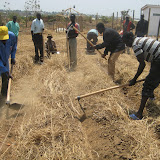
So the work is well underway in the village of Logo to prepare a ½ acre plot using the principles of conservation farming, known in 8 countries of Africa as Farming God's Way. Its exciting to see how the 19 farmers (9 members of Logo UMC and 10 of their village neighbors they invited) are working hard – and smart. They first cut a fire break around the plot, and back-burned it so that when (not if) the many fires that are set in the bush during the dry season reach the plot, it will not catch things on fire. Though there are not yet any crops to be damaged, and won't be until the March rains start, this fire break is still important since this method of farming surrounds the carefully spaced planting pits (maize) and furrows (groundnuts, sweet potatoes) with a 4-inch blanket of dried grass mulch that would flare up instantly.
But the progress I see is not just the fire break and straight rows of holes and furrows and the 3-pile compost system. It's also the willingness to defy the typical community-NGO relationship, and not demand everything be provided by the NGO. It's the willingness to undertake a development project as a spiritual covenant with explicit commitment for each side to partner by providing labor, materials, and prayer. It's the willingness to negotiate changes in the agreement, by offering to cut poles for fence posts in order to save money to be spent instead on extra tools and rubber boots. All this is possible because the project is based on a relationship in which there is trust, communication and flexibility. Because he trusted me, Pastor Simon tried a 6 x 7 meter plot of maize with this method, and it produced more than his neighbors. Because they heard him describe his success and they trust him, the members of his church agreed to let him organize them into a group to do this on a larger scale. Now as Alex Lupayi takes what I taught him and teaches them, he's developing a relationship in which the Logo farmers trust his teaching and advice. I've told them, and they've started to repeat it back, that when we use their demonstration plot as a teaching site for other villages it will be an inspiration and blessing to others who will trust that these village farmers, just like them, tried these methods and they worked.
In their own Kakwa language, their village name Logo means Strong.
Thursday, September 8, 2011
How do we start eliminating poverty?
In August Diantha and I attended the Sudan Roundtable, held in Uganda, with 6 of our Sudanese colleagues (pastors, laypersons, women, youth) as well as representatives of every United Methodist interest doing substantial mission in Sudan: East Africa Annual Conference; UMCOR, Women's Division and others from GBGM; Ginghamsburg United Methodist Church. The idea was to listen to representatives of the Sudanese United Methodist Church speak of their priorities, and talk about how we might increase our coordination and cooperation to meet these needs. A new District Advisory Committee set up by the new District Superintendent Fred Dearing had after much discussion and discernment settled on Eliminating Poverty and Reducing Killer Diseases as their first and second priorities, respectively. After two intense days of discussion in Uganda, we hope and pray that the resulting work by all the partners in mission in Sudan will continue to act on these priorities. As we reflected on them ourselves out of our one short year of experience on the ground here (and several years of work in these areas in the US) we came up with suggestions for principles that might guide the work of eliminating poverty, and that we are trying to practice:
1. Support projects that work with people, not just for people. We are currently using the church/village planning approach: the church/village picks the project area, the District sets budget limits within funding available, village and District work together to make the project fit budget. Building the capacity of the local church/village to manage their own development is more important than any concrete outcome: strengthening the experience of owning the process, learning to approach a big task/far goal step by step, learning to realize and bring their own assets into the project (materials, labor) so that the process is genuinely a partnership between the church/village and the District, and becomes culturally sustainable with local leadership beyond our involvement. Pastors appreciate being clear and consistent about following Biblical principles for the way the outside resource-provider assists the church/village for the up-building of all the UM churches in South Sudan. These include:
i. Equality (Acts 2:44-45) no one has too little or too much, and
ii. Accountability (Matthew 25:14-29) what have you done with what was given?
Diantha and I continue to practice these principles as we hold churches accountable to the changes they have made in their project plans, especially when that means they run short of money! We gently remind them as we have from the beginning that we have the same amount of money to help each church (thank you, Holston Conference!) and that if they change the project from the plan and budget agreed upon, they need to also take responsibility to find the resources to finish the project.
iii. Participation (Mark 6:35-44) start with what you have, even if it is small. We have been gratified to find how willing the church members and village neighbors have been to raise more money, to dig latrine holes, to make bricks and build school shelters, and find a variety of ways to contribute their part to the project benefiting their church and village.
iv. Planning (Luke 14:28-30) count the cost before starting. One or two churches have led the way by planning ahead and saving some of their harvest to provide seed for the next season; we have copied their example in providing all the churches with seeds on the condition they make a commitment to do the same thing, as well as planning to use some of the harvest also to help the needs of widows and orphans that are in each church.
2. Increase wealth by building on the asset base: this means that the main emphasis for the Sudan District UMC is on sustainable agricultural development which multiplies amount of crops that can be grown in a given area and in a given time by using improved methods of conservation farming while still using hand tools and homemade inputs rather than purchased fertilizer, pesticide, etc. Recently we have given each church a moringa tree and several papaya trees after the pastors attended a workshop teaching them the nutritional benefits of moringa and the medicinal benefits of papaya.
3. Improve the capacity to manage, not just increase, wealth. Projects eventually must be financially sustainable beyond our involvement. Our Microenterprise Program (PUMMP) teaches this to pastors and church leaders; we just graduated the first class of 6 pastors and gave them loans. Pastor Faustino of Ligitolo said, “This is the training we have been needing to improve ourselves!” Now we have started training a second group of 9 pastors in business management, this time in the local language (Kakwa), and we plan to hold training for churches on managing projects; to seek funding for a village savings bank program that includes financial management; and to develop workshop on managing personal finances for pastors, women, youth and other church leaders.
4. Start now developing leaders who can take over the work. One way to do this is to strengthen local leaders to get out of poverty themselves so that they can help others to do so, beginning with pastors, who receive little to no salary. Local people are increasing their ability to manage church/village planning (Pastor Isaac Sebit), manage the Eden Teaching Farm (Alex Lupayi), and manage the PUMMP training and the personal financial management training (Joice Jaka). With the help of short-term volunteer Thomas Sherbakoff, we trained 3 key church leaders in Basic Fund Accounting so they can handle the larger amounts of funds coming in to various District programs.
5. Make training a priority over equipment/materials. Many NGOs and mission efforts in the past have provided tractors and other pieces of equipment that are now lying unused, broken or rusting because of problems such as: Who can repair it? Where do you get replacement parts and how do you afford them? Who can afford the fuel? Other problems include disputes over ownership and management of the equipment. In our Basic Farming Methods training for 31 village farmers we gave hoes, machetes, and seeds only after they completed training; the pastors received a Moringa tree seedling only after attending the Moringa training. Diantha just coordinated a training for Traditional Birth Attendants that significantly increased the skills of 46 village women, who then receive 10 UMCOR birth kits each to carry out their new knowledge. We are hoping to get funding for a program to build the capacity of United Methodist Women groups so they can develop the capacity to handle income-generating pieces of equipment.
6. Look for and use collaboration wherever possible and appropriate. Many more people can be helped with many more services, resources and knowledge to reduce poverty by cooperating with other mission groups and NGOs. So, we have started monthly roundtables of other NGOs and mission groups working in agriculture, and in health. Christian Reformed World Relief Committee has provided free training and materials for workshops on maize, cassava, and sweet potatoes for 130 farmers in 2 UM churches. UMCOR is planning for UM churches to benefit from their projects in fish farming, poultry raising, cassava growing, beekeeping, renovating a remote primary health care unit, and community health outreach. We are providing UMCOR with business training for 220 farmers.
7. Seek sustainability to make poverty reduction permanent. Besides cultural and financial sustainability, environmental sustainability is key so the land remains an asset producing wealth. I had resigned myself to a gradual, difficult process of persuading people that this is a long-range investment that may not show results now, but will in the future. So it was wonderful to receive this letter from the pastor of Logo United Methodist Church, after he actually applied the no-till/mulch method I taught the pastors, to growing maize (corn) on a small experimental plot near his home: “We are very happy for what you taught us about agriculture. The maize seeds which you gave us 198 seeds for 99 holes give us three buckets which is dry now. Next year we want to arrange ourselves in a group. Let God give you more ideas for helping us. Thanks, yours in Christ, Rev. Simon Duku”
Thursday, July 21, 2011
A New Sudan
1. Independence Day in the New Sudan
The night before Independence Day, our new District Superintendent Fred Dearing received passes for us to sit in the bleachers to watch the official birth of the Republic of South Sudan. I was amazed at the diversity of the crowd gathered in Yei's Freedom Square to celebrate their first Independence day. It included not only the many Christian denominations that are here, but also local Muslims; not just South Sudanese from almost every state, but even Darfuris who sincerely celebrated the independence of their Southern brothers and sisters even while their home area in the western part of the North continues to suffer massacres of entire villages. It was great to witness that in the midst of their own celebration, South Sudanese pledged continued efforts for peace and freedom in Darfur. All the more amazing to realize that Independence is not just decades but centuries overdue for South Sudanese, who have been controlled, exploited and oppressed by others since ancient times without cease. In a sea of hundreds of banners, one summed it up in the words of Dr. Martin Luther King: “Free At Last.” People had walked to Yei from surrounding villages; some climbed trees to join the thousands enjoying marching and speeches in Yei's Freedom Square. Every local civic group and school had a banner and marched in a long parade; Salaam United Methodist School was there marching in their school uniforms. Sudanese women groups marched with banners proclaiming their commitment to playing a key role in the development of the new South Sudan. As we looked around us in the bleachers, we saw Sudanese young educated professionals listening intently to all the speeches, responding at times to commit themselves to the task of building a new nation. The highlight of the day was the simple act of lowering the flag of Sudan, and raising the new flag of the Republic of South Sudan. People cheered and ululated wildly, and that energy continued into the afternoon as dozens of tribal groups gathered in circles around Freedom Square into the evening to dance traditional tribal dances: Kakwa, Nuer, Dinka, Mandari, and many more. I hope and pray the peaceful, joyful spirit of those co-existing celebrations on Independence Day can be continued permanently into the complex process of becoming one nation of many tribes working together.
2.Oil and Food in the New Sudan
Petrol (gasoline) prices in Yei have risen to about $6.80 per gallon, but farther north in Unity State they are over $10 per gallon, down from $12 per gallon during the height of the fuel shortage a few weeks ago. Even though 75% of the known oil is located in South Sudan, all the pipelines and processing are in the north, and the north stopped allowing shipments of oil after the vote to separate. Oil from other countries has slowed down, reportedly because Libyan oil production has been disrupted. South Sudan is working on arrangements to build a pipeline through Kenya to a seaport, but that is expected to take 8 years. Meanwhile, higher fuel prices mean higher food costs (over half the local food is still imported and trucked in.) Already food prices were rising independently of this crisis; according to the South Sudan Minister of Agriculture Anne Itto, maize (corn) prices in Kenya rose 130% in the first half of 2011. Adding to that the fuel crisis in South Sudan, Itto says maize prices have quadrupled here (Sudan Tribune 16 July 2011). The conservation farming methods we're teaching here are increasing yields by 6.5 times in Zimbabwe just using existing hand tools with no commercial fertilizers (Conservation Farming in Zimbabwe: Evaluation Report, January 2011, Canadian Food Grains Bank.) If we can show that these methods do even half as well in South Sudan, it could help increase food production here quickly and inexpensively.
3. Training Leaders for the New Sudan
Elizabeth Heft, an Individual Volunteer in Mission from Ginghamsburg UMC in Ohio, is here for 6 weeks as an Individual Volunteer in Mission conducting training for youth leaders of the 17 United Methodist churches in South Sudan. It was exciting to see 35 Sudanese young adults, about 1/3 women, gathered for the 2-day retreat here in Yei. Elizabeth and Peter Lomorro, the Youth Coordinator for Sudan District, did a fantastic job of providing much appreciated training while the young adults provided joyful worship with drums, shakers, song and dance...and fervent commitments to the task of leading and teaching youth in the remote village churches. Looking over this group of energized young women and men gathered in Yei UMC as we celebrated communion on the final day of the retreat, I was moved with the knowledge that faith development among the youth of the village churches would take a major step forward, and astounded to realize that several of these young adults would be, in a few years, pastors of these and of new churches. What an incredible gift!
Wednesday, May 11, 2011
Mission in South Sudan: May 11, 2011
Hankins Leave Sudan
There were tears, prayers, singing and heartfelt thanks as Boo and Phyllis Hankins met one last time with the United Methodist pastors in Sudan District. After two years of mission service in Sudan Boo and Phyllis Hankins are leaving Sudan, to return to serve churches in Tennessee at the request of Bishop Swanson of Holston Conference. In fact, they left 3 days ago after preparing Diantha and I to respond to interim tasks such as unexpected medical needs of pastors and the ongoing support of several orphans and sponsored students. The Sudanese pastors thanked them for strengthening the churches and teaching them English and more. Their fellow missionaries thanked them for their example of teamwork and endurance as they persevered resolving crises in church and school. Diantha and I are grateful that God used them to do the difficult pioneering work in the development of the church here, work that not many others we know would be able or willing to do. Twenty-two years of the traumas of war and refugee camps leave deep wounds in peoples' hearts; in the case of the Sudanese United Methodists, these wounds have been exacerbated by the corrupt behavior of several former local church leaders which has deepened a prevailing sense of mistrust. The Hankins have worked step by step with these church members to build stability, continuity, and a sense of being part of a much large connection that will not let them be the victims of the whims of individuals any more.
Women's Division Team Visits Sudan
Two staff (Marva Usher-Kerr, Carol Van Gorp) and a Board member (Ollie Pleggenkuhle) of the Women's Division of the General Board visited South Sudan in April. They held a workshop for the United Methodist Women leaders to help them develop come together as a district, and develop some goals. In preparation for their visit, Diantha researched the existing programs for women's literacy in South Sudan, and the effectiveness of different approaches. We are hoping for their continued support of agricultural training for women, and continue to explore with them a possible approach to increasing the literacy of women, and of beginning village micro-finance programs that would put management of credit in the hands of trained village committees controlled by women.
Reducing Poverty: Our thinking advances...
For 9 months we have been thinking day and night about the issues of poverty we see daily: hunger, lack of money to pay for school fees or medicines. We can see now how the pieces might fit together to allow people to improve their life situations: now they have little income, so there are always more demands and urgent needs and their culture encourages them to help others rather than saving. If we could help them start micro-finance programs, in the future it would allow people to add up small savings in a village "bank" that they manage collectively, and learn to manage their money, which could be used to start income-generating activities or to pay for household needs such as school fees and medicines. There's another key piece of the puzzle: they need to improve their income, which in rural South Sudan mainly means improving agricultural yields and income so they can grow enough for their families, and have some left over to sell. Yet another piece: health is important. If they learn to improve their health and even to grow some of the medicinal plants they need, they are strong enough to contribute to the family income; but if they are sick, they deplete the family income.
Collaboration Blossoms
"How very good and pleasant it is when kindred live together in unity!" (Ps. 133:1) From the time we got here, we've tried to get to know the other groups and people at work in South Sudan, especially in health, agriculture, education and micro-finance. The result last fall was that Diantha was invited by an NGO to help create a manual for training community health workers, and I was asked to be part of interdenominational trainings for pastors youth. At our request, another mission group provided our UM nursery schools with digital players with a variety of teacher training lessons on them. In March we contracted with a Christian Reformed group to provide training for 31 farmers from United Methodist churches. We were concerned that there was no regular gatherings of people doing similar work, to share progress and consider working together; so Diantha and I played a key role in starting monthly informal "teas" around agriculture and another around health. Since then the cooperative work has exploded: the same Christian Reformed group has offered to train for free, two groups of 50 farmers on improved cassava and sweet potatoes from two different villages where there are UM churches; UMCOR is working with us to select one of our remote UM churches for a fish-farming project and is trying to set up a health project so that it benefits another of more remote villages where there is a UM church. While our budget is tiny compared to the other mission and NGO groups here, or perhaps partly because of it, a lot is happening to help the villages we focus on, because of the growing willingness to collaborate.
Saturday, April 2, 2011
Mission in South Sudan: April 1, 2011
Farming God's Way (FGW) Moves Forward
Small steps forward for this method of conservation agriculture in which soil fertility and scarce water is kept and increased both by not plowing and by covering the ground with a layer of mulch; and by adding natural fertilizers like composted grass and manure. FGW incorporates principles from observing Creation and from the Bible that works well to teach these methods in the villages of south Sudan. I held a workshop February 16 for 19 UM pastors and assistant pastors (I expected 10!) to introduce them to FGW; as a result, so far two pastors (from Logo and Mirodu villages) reporting to me that they have prepared a sample plot using these methods and are ready for me to supply them with maize (corn) seed so they can try it out! This makes me very happy. As of today I am proud to announce that Eden Teaching Farm of the Sudan District has officially begun what the new UN report on agroecology (conservation agriculture) calls "decentralized participatory research."
Not only that, but these methods may help Darfur in the north of Sudan. I've had a couple detailed email exchanges with a colleague in Darfur who hopes to use these methods there, and have tried to help her figure out how to adapt the the FGW methods to that area which has drier climate and scarcer resources than we in the south. I'm eager to see what may work there.
Steps forward on the global scene too: I've just discovered a new UN report (December 2010) advocating strongly for increasing the practice and scale of agroecology to increase food security and help small farmers worldwide; and a decision by the Food and Agriculture Organization (FAO) of the U.N. in June 2010 to promote this "integrated holistic approach" for sustainable crop intensification. They even mention the importance of "learning by doing" and of partnering with non-governmental groups at the local level. So far the farming methods we are beginning here is not yet widely accepted or practiced in Sudan, but this tells me it will be promoted more and more. I'm encouraged in my work and thankful to be helping the villages and churches we work with to be involved at the beginning of an important movement.
Steps Forward in Development Hearts and Minds, too
We (mostly Diantha due to my limited mobility on motorcycles) have now completed basic strategic planning meetings in 13out of 17 villages, a process we began last September. We had no idea it would take so long! But we're excited by what's happening. We invite each church to choose an initial project that must meet 4 criteria: (1) It must address a top priority identified by the village during the planning meeting (2) It must involve investment by the village of labor, materials, or both (3) It must require no more than US $150 from us (4) It must be able to be started soon and completed in 4 months or less, so that the church and village have an immediate sense of succeeding in the long path to development. The results are interesting: Three churches have chosen an initial project in agricultural training because they reason that increased production will mean they have more food not only to eat but to sell to get money for school fees, medicines, and other crucial needs. Seven churches have chosen to build an additional school "building" (simply a thatched roof) so they can move more classes from under the trees and expand the number of village children who can be educated (for many of these children the church school is their only option as they cannot afford the higher fees of the government schools, which also may be too far away to walk to). And one church has chosen to build latrines so that their school children can improve their health. One church wants help to get culverts in the road to make it passable in the rainy season and allow their children to walk to school even in the rainy season. The reasoning behind their choices are gratifying. So are, increasingly, the comments made during the planning process. We always ask early on in the meeting for a list of things people are thankful for, as well as (inevitably) a list of what they need. During the first planning meetings last fall, the lists were predictable: they were thankful for their church and the local school the church had begun, the seeds and tools they have been given, the bore hole (deep well) dug with funds from US churches. But since the Referendum in January, the list of thanksgivings have been changing and deepening. We hear thanks for the Referendum, thanks for freedom and peace; and we often hear thanks for the improved life of women. Women are thankful for liberation from the fear that a harsh version of sharia (islamic) law could be imposed on them; thankful that the new government is making a commitment to the rights of women including making women 50% of all government leaders; thankful for a focus on decreasing gender based violence. While the villages and the churches, like the towns and the government, still have a long way to go to put all these changes into practice, its great to hear the excitement and hope in these comments. We feel privileged to be here, doing this, at this time.
Subscribe to:
Posts (Atom)