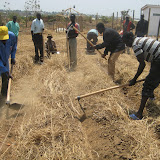
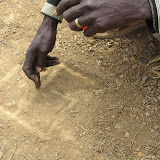
We have had three U.S. doctors here for a week, in part so that two of them (husband and wife) could continue their discernment about whether God might be calling them to Sudan next year. Diantha and I really hope so. They are particularly interested in improving the rural health situation, including preventing sickness through improving health practices in the community, which is our focus as well, and it was greatly encouraging to us and especially to Diantha to think we might have colleagues to work with on this. Diantha and I urged that their schedule while they were here should include some meetings with women and others from the villages to ask them about the health situation in the villages, and to answer their questions about medical matters. The three such "hearings" (plus another with the United Methodist pastors) were great, though exhausting. One piece of good news we gleaned was that the WaSH --Water, Sanitation, Hygiene -- training Diantha has been doing is well accepted and appreciated. The bad news was the reminder that the cost of medicines, of getting to the clinics in the main city of Yei, and of the clinic fees is prohibitive to most people. Time and time again the doctors' answer to a medical question quite rightly was, "You need to go to a clinic and be seen." It really came home to me that the only way that this huge barrier will be overcome in the long run is to help people increase income so they can afford these costs; this is another way my agricultural and economic development work is connected to the crucial work of improving health. And another distressing bit of news was that almost no one in the villages we visited had bed nets! The exception was those pregnant women who went to prenatal appointments (not all did) and got one bed net. The NGO that was giving them out free last year has ended that program. Diantha and I will begin some fundraising right away to buy 5 or 10 bednets at least for each of the 17 villages we are working in.
To relax last night, we watched a movie the Hankins brought with them, K-PAX. It was a powerful reminder of the huge impact of personal trauma (one character's wife and daughter are killed) on an individual's ability to cope and live in reality. My immediate thought during the movie was that we are living among a whole people under this kind of Post Traumatic Stress. So many here (estimates are about 50%) have experienced such a trauma, and it can't help affecting the way they live and relate to each other and to us. So many have seen family and friends brutally killed, seeing neighbors fight over resources in the refugee camps and the bush where they have been for 20+ years, so many have felt and still feel left behind or feel guilty for leaving someone behind, so many have been treated as less than human by not only by enemy soldiers but sometimes the host population around the refugee camps. While I know some of what surprises us here is a matter of a different cultural attitude toward money and relationships that we are learning to respect, still I wonder if widespread PTSD -- or something like it -- at least partly explains some of things we've noticed as we've gotten to know people here: the fear of being forgotten, mistrust of each other (and us), difficulty in accepting rules and authorities, and grabbing resources for oneself at the expense of others. I suspect that the implications for our life here include (1) be very patient with people even when they disappoint us (2) make it clear again and again that we are here for several years to devote time, knowledge and some resources into a series of developments they think are important (3) follow through on anything we promise to do and not promise anything we can't do (4) continue working hard at building friendships and relationships that are genuine and respectful. To do these things I think we'll have to make a serious commitment to listen, especially before we speak; a listening that includes learning about their culture, and a listening that includes trying to take into account the traumas of their lives.
Sunday, November 7, 2010

Saturday, October 23, 2010
Mission in Africa Week 9
On Monday, Oct 18 Edina Tumalu, one of the church leaders here, gave birth to twins!! Everyone is so thankful she is healthy and the babies are healthy!! She had some rough spots in her pregnancy; she recognizes God’s mercy and is thankful for the medical care she has received during her pregnancy and for the birth (in more common circumstances here she would have died). She is also thankful for the key support people from Holston have given her. Not everyone can access medical care. She has been going to the best obstetrician in town, Dr. Wole, who is an MD, has an ultrasound, and does surgery. The twins were just over 37 weeks gestational age, and though they are a bit small, they are fine and are now nursing well. The boy is 5 lb.7 oz. and is named Willfred Swanson (for God’s Will, Rev. Fred Dearing and Bishop Swanson); the girl is 4 lb 9 oz and is named Phyllis (for Phyllis Hankins) Desire. On her second day she was very lethargic due to some low blood sugar and an elevated temperature, but recovered the next day with some glucose and antibiotic and is now doing great (again, in the average situation in Sudan, the baby would have died). I feel blessed that I was able to be of some support and help during this past week. Edina called us Monday afternoon. She had some labor, and was admitted for a cesarean procedure , as the babies were not in good positions for vaginal birth. Boo, Phyllis and I went to the clinic right away, while Steve rallied prayer supporters by email and on Facebook. The clinic was waiting for the payment before starting, so Boo, through Holston Conference, was able to loan the money. We could peek through the curtain of the hallway which led to the operating room, and saw the babies as they were just born, and handed to the nurse to dry off! In Sudan, the family has to provide supplies and a lot of the care, so the babies were handed over to us and Edina's two aunts (see photo) to take care of (Edina’s husband was in Juba attending school). Edina came in the room soon. Her husband arrived this weekend; she should go home Monday. They keep mothers for 7 days in the hospital until their incision closes, as so many women return with infections if they are sent home earlier. I think this length of time will give Edina more rest and more chance to nurse the babies than if she were to go home. (She has a son 4 years old and daughter 7 years old, plus is taking care of 3 other orphans, and has a widow living with her who helps out.) She has several tukels (little one room houses) in a compound with a garden, next to her in-laws, and has needed the support that Holston has given her.
The clinic rooms are small and have two beds. Fortunately they have mosquito nets, as the windows have no screens. The beds are about two feet apart, and the door does not close. The conditions are not as desperate as at Yei public hospital, but they are not anything like the clean hospitals we have in the US. I was happy to be able to come back several days this week to support Edina in getting breast feeding started for Phyllis Desire, and be of general support. It has been quite some time since I had the chance to be of service, and I wasn’t sure how much support from me Edina would want. She told me in Sudan many women do not breastfeed until their milk comes in, which can take a few days. I’m glad she was interested in feeding anyway, so the babies can get enough food and gain the incredible immunity that the colostrum gives in those first crucial days. Also, they do not wash the baby with water for the first one or two months, but scrub them with cassava flour. Edina, however, was OK with using water! Phyllis Hankins was able to buy some clothes for the babies, as Edina only had cloths for baby blankets and no clothes. You can buy used Western clothes in the market, and that is the best place for baby clothes. The new clothes here are few and more dresses than little shirts.
Steve and I have both been working intensely to meet the November 1 deadline for applications for Advance Special Projects, which is how United Methodist Churches give designated money for specific projects. Once approved, churches may then donate to the project, and money is turned over as it is received. The application is similar to a four year grant application, but the approval of course does not guarantee a specific amount of funding. Actually it has been good to have this structure to project our workplans for the next four years. Steve wrote one for micro-finance (people can choose a village savings and loan program, or microenterprise start up help), and just finished a another for agriculture development. Now he and Boo are working on one to construct “permanent buildings” for churches (with concrete block walls and metal roofs). Buildings would double for the nursery/primary schools. All 17 of the Sudanese United Methodist congregations are asking for permanent buildings to replace the thatch roofed, wattle-and-daub structures that now serve as churches and schools.
I have been working on a church/village health project. The challenge I've been struggling with is to make sure the final impact of the project is saving lives. South Sudan health indicators are some of the most desperate in the world, caused by a combination of poverty, poor transportation, lack of functioning clinics and hospitals, lack of clean water (most of our churches now have wells giving access to safe water), lack of soap, lack of latrines, and poor sanitation and hygiene practices in the homes, lack of education and poor or wrong information about disease and prevention. So much can be done with health education and promoting disease prevention. For example, diarrhea kills especially children under 5, because of the poor sanitation and lack of latrines. Actually the resulting dehydration kills them, which could be remedied with homemade oral rehydration fluid and some basic knowledge. If everyone in the village has clean water, latrines and good handwashing, 80% of diarrheal disease can be prevented. Well meaning people have gone into villages and built latrines before. The villagers then feel like the latrines are owned by the builders, who should have the responsibility to clean them and keep them up. If the people do not understand their importance, they may tear them down to use the parts. If they don’t understand how disease is spread, they will not take all the many steps needed for general cleanliness. Though the solution seems simple, there needs to be a lot of health education, starting at the most basic level, and very thorough community involvement, training of committees, training of individuals to go house to house, and some time for change. I think there is lots of misinformation about the causes of various diseases, how the body functions and how to prevention disease. The horrible maternal/infant death rate (among the worst in the world) has a complicated solution too. The government of South Sudan has a good plan to establish rural health centers with birthing rooms. The problem with these, currently, is that there is not enough money for staff and medicines (part of their long term problem is there is no way to transport a mother for higher level care because of impassible roads, no ambulances and few vehicles). There is a 6 month training program for midwives, but trained women would rather find a job that pays rather than work at the public centers, where there is also no money for equipment for the birthing rooms. The midwives at the centers are supposed to train the Traditional Birth Attendants (TBA) in the villages, and give them supplies (which is unlikely). Most of the births occur in homes with or without a TBA. So I'm planning my work to complement this effort; I started with a simple plan to help distribute basic equipment and supplies to the midwives at the government health centers. That could save lives with a trained midwife. Steve encouraged me to keep working on a plan that could make that difference with TBAs as well, since they are on the "frontline" in the villages. Currently while there is a little training in south Sudan recently begun for midwives, there is no training program here now for TBA’s. By the end of the afternoon I had drafted a core curriculum and basic skills list with needed equipment. (It was exciting for me to get to use my midwifery knowledge again and love of teaching). With birth there can be an impact on improving infant and maternal health by making sure the mother has good nutrition, is healthy, and with some non-technical measures, but you have to have some knowledge of what to do. All these plans add up to more than can probably be accomplished in four years. We shall see! It eventually will take contracting with some trainers who are already here as well hiring a couple people part time to help me, which would be good also for preparing someone to continue the projects after we leave.
We are all very excited that AROSS, a local Christian group, including our churches/schools in their educational program. In our photos this week you can see the “megavoice players” being given to the pastors to use with their congregations and schools (see photos). These players have 40 lessons for teacher training, 4 lessons on sanitation and hygiene, and 3 which narrate the story of the Bible in English and Bari (local language.) They can be set up for small groups to listen to. All the churches have been asking for teacher training, and now they can some help in this area!! It is a great example of appropriate technology. Lessons can be added later on other topics as they are developed. There will be more coming out on health as well. The pastors were quite intrigued, excited and appreciative. Some of them are not familiar with any level of technology.
We have gotten some good feed back on the sanitation training I did a month ago. I passed out two additional handouts based on the training which were translated into the local language, with pictures so it can be used with those who can’t read the words. Several pastors said they have made “tippy taps” for handwashing.
The government of south Sudan is making plans for the referendum. We don’t have any reason right now to be worried about our safety, and we have a good network of well informed people here who keep us updated as needed. Steve wrote a sample advocacy letter to be used in the US. If you are interested, you can find the link at www.holston.org/about/communications/the-call/volEE/num31/sudan-advocacy-letter/.
A bit of personal news: the new house (Captain’s House) that Boo and Phyllis will live in is coming along. They should be ready to move in a few weeks. We have been gradually buying the things we will need for our household here at the UMCOR Guest House when they move out, including plates, silverware, bednets, and ordering furniture to be made (you can’t really buy ready made). I am thinking of Tennessee fall and seasonal foods. We can get some nice greens here (amaranth) and I cooked a local pumpkin, which is close to texture and flavor of acorn squash. We're blessed with access to a great variety of vegetables and fruit!
Monday, October 18, 2010
Mission in Africa Week 8
Frustration. I've been thinking about frustrations this week. The rainy seasons adds an element of unpredictability to each day. Boo and Phyllis and Diantha and I took a chance and planned a trip to Goli, mainly so that Faustino and Peter could check out the pastor training program and take an oral test of their English ability. But it rained especially heavily the day before, so the roads were even more of a muddy mess than usual (see photos.) We almost got stuck (that made the folks in our Landcruiser tense); and the doctor driving the Evangelical Presbyterian Church car did get stuck, we had to pull him out. My most frustrating time in Sudan so far was the Sunday before, when I slipped and fell twice in the mud while on the motorcycle. I wasn't physically hurt, but arrived at Morre UMC very muddy and feeling upset and humiliated. It was a gift of grace that the church members at Morre didn't seem to mind how I looked, and asked me to preach anyway. Then I spent a couple days inside with some kind of stomach flu. About midway through the week someone remarked on how much suffering the Sudanese people we know put up with, on a regular basis. We know so many with malaria, typhoid, serious injuries, who keep working right through because they have to. They routinely walk long distances, carry unbelievably heavy loads, and do hard physical labor in the hot climate (see photo of Nyoka). I started thinking about how insignificant my frustrations really are; and how much we who are here from outside Sudan need to do a better job of "getting over it", spending less time complaining and letting small things restrict our activities. When I get my attitude adjusted to the reality of the lives of people here and the bigger context of where God is at work and my place in that, many of the things I think matter turn out not to matter: being muddy doesn't matter; being embarrassed doesn't matter; and its not the end of the world to feel sick.
Scale. I've spent most of the week at home, working on a couple funding applications that could help us address health, sustainable farming, and building churches and schools on a larger scale over several years. Writing proposals is a familiar activity for me, one I feel confident I can do, but I feel uneasy. I know from experience that it's so easy (especially for me) to be focused on large schemes to impact many people, that I'm not spending as much time being available for encounters with individuals, for building relationships. On the other hand, I see the real temptation as missionaries to be so caught up in responding to a string of crises that individuals have, one person after another, that we don't take the time to figure out and make the changes on a larger scale to remove the causes of these crises. It's like the hospitals in the Congo that Dr. Dan Fountain told us about (in the Health and Agriculture Workshop I took last April) that are so busy with treating patients with problems like roundworms, they don't think they have time to develop a community health outreach that would greatly reduce the roundworm problem by increasing handwashing and latrine usage. So is the answer to find a balance between the large scale and the small scale, some way of doing both? Do each of us here doing mission need to seek that balance in our own service, somehow? I worry if we settle for doing one or the other, because I know clearly for myself that I need to leave myself open to the personal encounters that make the work here real, and yet I would really hope that we missionaries would not miss the forest for the trees, that we would stretch our minds to seek what can be changed on a larger scale to make health and livelihoods better for these very people and many more like them that we may never encounter, but whom God loves too?
Giving. The question for me is not whether to give; I/we have so much, and clearly God wants us to share it with those who have so little. But the questions are how much to give, how and when to give, for what purposes, and what does it do to the people we give to? I've read a whole book on this (African Friends and Money Matters) and been here two months and it seems like I ought to have a better handle on this, but I don't. After talking with two Sudanese colleagues who work for another NGO, I understand from them that many Sudanese formed their attitudes about getting money from foreigners in the refugee camp experience; it was an extremely lopsided relationship in which the NGOs were set up to give away stuff, and the refugees had nothing and little opportunity to earn/farm anything for themselves. For me the challenge is somehow to share the abundant resources I have in a way that doesn't simply reinforce this dynamic. A few ways that might work are (1) providing part but not all of the cost of something (tools, seeds, medicine, etc.) (2) investing in someone's training especially when they have a clear commitment to put it to work to benefit others. (3) providing the staffing that makes a beneficial development program possible, but expecting the participants to cover most or all of the other program costs. I'd like to figure out some more.
Tuesday, October 12, 2010
Mission in Africa: Week 7
This week I (Diantha) went a second time to Lasu near the Congo border with some colleagues from UMCOR (United Methodist Committee on Relief) who were going back to see the Congolese refugee camp and the UMCOR work there (a bumpy 1 ½ hour drive; a few weeks ago we were at the opening of the school). I wanted to go in order to see the government health center that UMCOR helped by improving the existing building and giving supplies for the midwife there. They have free care and medicines (not all centers actually have staff and medicines). This health center which is the only health facility for miles, is staffed by a medic who sees sick people, gives immunizations, dispenses from their simple pharmacy, and is in the future supposed to provide preventive health education in the community. They have one medical bed (see photo).The midwife does maternity education and care, including births for which UMCOR brought thermometers, a birthing bed (behind the screen in the maternity room in photo), BP cuff, simple supplies for births, fetascope, and otton cord to tie the baby's cord. They already had gloves. Many rural centers like these have little to no supplies for births. And even here in Yei, a city of over 200,000, women who go to the government hospital must bring gloves, a cord tie, and everything for the birth. The midwife at Lasu said the mother is only supposed to bring a blanket to clean the baby with and take it home, except even then she often has nothing, and the baby goes home naked, or she cuts one of her blankets or sheets to use.
At the Lasu refugee camp we also saw the schools, with a metal roof supplied by Across, a Christian NGO, and bamboo half size wall built locally. UMCOR was pouring the concrete floors for the school. I am told the refugees have enough food for 2 to 3 meals a day (more than many Sudanese have). The children were dressed sometimes in shreds of clothes, but had a happy smile for us. They were growing rice (not the wet paddy kind) and other things in their gardens. Agencies are providing additional food, a medical center and schools for them, and uniforms, which are bright, new and whole garments.
Yesterday we had a long service at Mirodu UMC, a rural church, for "Pastor's Forum", an event where all the Sudanese pastors are try to visit one different church a month, and have a special service. It was also World Communion Sunday, which for us was a nice connection. There were baptisms of 4 infants, and Boo and Phyllis were asked to serve communion (see photos). These are new practices for the pastors, so they do not yet seem to feel confident to do them on their own. Communion was an easily accessible cracker, with water in a tin cup. There is some bread here, but no grape juice. It was very moving. All the visitors were asked to introduce themselves, and I also mentioned it was World Communion Sunday and that my pastor brother Dave had talked to me just the day before asking how we celebrate communion, and for some ideas to share with his congregation. I told them many, many people would be praying for them that day!! Boo did a nice job in explaining communion and the about the New Covenant. He explained Passover, when the Israelites were freed from slavery, as the Old Covenant. There were some flowers on the alter table, in a reused plastic soap container. So he made a demonstration out of it, saying the use of this soap container is now made new, just as Jesus gave a new meaning to Passover when he began the Last Supper. They also had a time for prayers for those who need healing. Those who are ill or are representing sick family member come and stand or kneel in front. Others lay hands on them, pray and anoint them with oil. Usually Phyllis heads this up. The last team that visited gave anointing oil to all the pastors. So this time, Phyllis deliberately stepped back and the pastors did the praying. Progress!
While we were at the church, we brought 2 blackboards Holston Conference had provided for the church’s nursery/primary school made up of 5 classes (see photo). These are the only supplies for these schools (even the teachers do not have books to teach from). Schools here are operated out of school fees, but in the rural church schools, pupils do not have the fees, for the most part, so teachers are volunteers. Later in the week Steve and I rode our motorcycles, and Sebit, the Sudanese Assistant to the Superintendent and interpreter, accompanied us to visit Morre UMC, the newest rural United Methodist church. Steve was asked to preach once we arrived. On the spur of the moment he gave a great sermon based on Jesus feeding the five thousand, how Jesus needed the people to come up with the little they had, to step out in faith in spite of an overwhelming task. They have 5 classes covering 7 grade levels in their school, and are constructing a second thatch structure to use for school in addition to the church structure (see photo). We were also excited to see that at the school structure they had erected a “tippy tap” for hand washing, a simple device which we introduced at the health and sanitation workshop last month. Several pastors mentioned they have made them, and Pastor Mukasa of Morre showed us the one he had made (see photo.) It encourages hand washing (which isn’t practiced often, especially with soap) using very little water. The church had beautiful church gardens (see photo), using the tools and some seeds that were donated. We are encouraged by all of these signs of advancement.
The 1 ½ hour motorcycle ride is a story in itself, especially since it was our first ride out of town. The main Kaya road had been worked on in spots, so we were able to reach a top speed of 25 miles an hour. We cut off that road and went about 4 miles down what you could call a lane with one or two tracks, with tall grasses on either side, rocks in the road and mud holes. The motor bike spilled only two times (we were unhurt, as the speed was about 2-3 mph, but got muddy). The scenery was beautiful, and we passed a few tall stone hills which just rise abruptly out of the ground. One time when we were stopped with the motors off, I heard about 5 kinds of birds at once (we see/hear just a few birds here in town). On the return trip it looked like the skies would open up with rain, and the drops were starting as we approached home and made our way carefully through the small herd of cattle taking up the road!! In addition, Steve got the stomach flu during the visit (he is almost better now), but had the ability to drive the motorcycle home. Our prayers were answered and we arrived safely.
This is my one year anniversary of being diagnosed with breast cancer. I am celebrating with thanksgiving for healing and continued health, and putting the experience farther behind me. October is breast cancer awareness month, so I will add my voice to remind women to do self breast exams. Thirty minutes of exercise a day (or 2 ½ hours total per week), eating preventive foods, plenty of vitamin D (at least 30 min. a week of sunshine exposure; most people probably need supplements) are good preventive measures. Celebrate the health, family and friends that you have!! Many of us can be thankful for access to a cleaner immediate environment, health care and medicines, unlike the situation here in Sudan for so many.
Saturday, October 2, 2010
Mission in Africa Week 6
Affirmation: Several encouraging conversations: (1) When we describe our intent to facilitate a congregational/village planning process to lead to projects in health, agriculture, income-generating projects, Pastor John Kenyi says "we spoke and you listened; thank you for your sweet words" and Lasu Payam (sub-county district) Director says "You have the best plan" (2) When Diantha describes the regional women's trainings she wants to do with Methodist church women and the traditional birth attendents from their villages, Poppy Spens (UK missionary ) tells us she's been planning the exact same thing with Episcopal church women and suggests we collaborate (3) John Spens (also UK missionary) agrees that if I can come up with some additional funding, the Episcopal church's women's microenterprise program could be expanded to include women from the United Methodist churches as well. (4) We meet with the County heads of Health and Agriculture and they are genuinely happy for our presence and our plans.
Boda: This is the word for motorcycle locally. I've been riding it a lot more than Diantha, but am having trouble with it stalling almost every time I try to start it. When Diantha goes to practice, she has no trouble at all; she shows me how to give it more gas as I let the clutch out. So now that she's taught me how to start it, I'm teaching her how to think ahead about downshifting so she can stop it without stalling out. Boo just borrowed the boda to get familiar with it in case he needs to borrow it one day when we need to use the Land Cruiser.
Culture: A couple fundamentals about Sudanese culture that shape our days: (1) Relationship, relationship, relationship. From something as simple as being sure to say good morning to every acquaintance, to understanding the importance of the handshake as an affirmation that you are focusing on the other person and acknowledging their worth. Even better if you ask about their family, or their crops, or something that shows you are putting your attention on them. I still remember a couple striking instances in which a church member has said that "You came and visited us and promised to come back and to help, and we felt we became somebody." Its hard to imagine how dehumanizing the 22-year war must have been. We who feel frustration with how slow cooperation, trust and maturity can be must keep remembering how deep this dehumanization has been. (2) Wealth is to be shared. A fundamentally different view of wealth and possession. Unlike the assumptions of westerners here like us that we have a right to our possessions, both our stuff and our "space", the conception here is that those who have wealth have a responsibility to share it with those who don't. Also the assumption that its more important for donated resources to be spent on the greatest need that presents itself even when that is not the intent of the donor. I think the African assumptions are far closer to Biblical teaching than our western assumptions, even though we tend to get bent out of shape and grumble when people don't exhibit the western assumptions. (3) Knowledge is highly prized. The book African Friends and Money Matters say the many Africans share resources more readily than knowledge. I haven't observed that yet, but when we visit a church we always hear clearly that they value the knowledge they believe we have to share with them and are excited and hopeful that it will make their life better. It makes me want to get back to the villages quicker than we seem to be able to do, thanks to the rainy season making roads difficult.
Devotions: I've been re-reading Thomas Merton's first journal, Sign of Jonas; p. 82, "If You allow people to praise me, I shall not worry. If You let them blame me, I shall worry even less, but be glad. If You send me work I shall embrace it with joy and it will be rest to me, because it is Your will. And if You send me rest, I will rest in You. Only save me from myself. Save me from my own, private, poisonous urge to change everything, to act without reason, to move for movement's sake, to unsettle everything You have ordained. Let me rest in Your will and be silent. Then the light of Your joy will warm my life. Its fire will burn in my heart and shine for Your glory. This is what I live for."
Education: What a week for learning. I'm learning about fish farming as a real possibility here and the pros and cons of using improved cassava varieties. Diantha is learning about how midwifery is and isn't practiced in the rural health centers run by the government, about community health committees and community health educations supposedly in every "boma" (like a township, a 10 mile x 10 mile area). We're both learning where there are and aren't functioning health clinics, some of them mobile clinics that come in one day a week, and sharing that information with the pastors of the 17 United Methodist churches so they can educate their member about it.
Farming: Gradually five weeks of listening, reading and thinking are taking shape. There are several NGOs (=nonprofits) already doing some excellent agricultural work here. One of them (Christian Reformed World Relief Council) has conducted an excellent baseline survey, and just finished training 833 farmers in the area; I hope to be able to get some of the farmers in "my" villages into their program the next time, which will be the end of the dry season in February before the March/April rainy season begins. Their survey shows that the major barrier to growing enough food for their families, much less for commercial markets, is "labor". What this really means is that using hand tools (hoes, machetes, axes, spades) and traditional cultivation techniques (turning over the soil before planting, minimal irrigation) the typical family is not usually able to cultivate enough land to feed themselves and produce food for sale so they can meet their cash needs for buying other food, medicine, school fees. So the answer of the NGOs, the Government here, and of the new USAID grant to south Sudan is to provide more tractors which will be rented to farmers at a subsidized cost. As a short term strategy, I will probably promote this program with the farmers in the 17 villages I am working with (each of the villages where there is a United Methodist church.) But I have problems with it as a long-term strategy; both on the basis of financial sustainability (how will the impoverished farmers come up with the rental capital in 4-5 years when the program ends?) and environmental sustainability. I have been studying no-till and minimal-till agriculture and I think it could hold the future of sustainable farming for these folks: it retains much more of the fertility of the soil than plowing, or at least of inverting the soil when plowing. And pilot projects elsewhere in Africa show that once the no-till/minimal-till plot is established in one or two years, it decreases labor time by 40% for the same amount of acreage, while producing anywhere from 3-9 times as much yield per acre. To move to these methods will take time and persuasion, so I am thinking about establishing a demonstration garden that allows people to see plots side by side illustrating the different methods and yields, as a hands-on teaching tool. If this works, it might persuade a village to try this on a limited basis. There's a whole system of Limited Input Sustainable Agriculture (LISA) which combines minimum-till, near-organic conservation agriculture with an emphasis on perennials that allow food production during the dry season, animal confinement (almost all animals roam free almost all the time, wreaks havoc on gardens), etc. One mission organization has put this together in a way that I think will work with the predominantly Christian villages in our area of south Sudan; www.farming-gods-way.org/FGW.htm
Sunday, September 26, 2010
Mission in Africa Week 5
Here are the highlights for Diantha from the week:
Sunday at Yei Church (see photo): Phyllis Hankins has been teaching people to bring offerings of food from their garden if they don’t have money, to help support the pastors and teachers for the church’s schools (who are all virtually unpaid). People are now starting to respond. Saturday at Diantha’s health workshop for 43 United Methodist women, we gave them each 8 bars of soap, sold in a row, and suggested they could give one bar each to the church and the school. Sunday, one of the women who had attended this workshop brought a big tub of her peanuts and a dozen ears of dried maize wrapped in a hand embroidered cloth. After church the pastor auctioned it off (which was a lively scene) for about 4 times their value. Apparently other churches do this as well. The only way the church’s schools here can pay their teachers is to charge school fees, and the people in the rural villages are subsistence farmers, without much cash. Money was donated so each school has a blackboard and chalk. They have little else (no books, etc.). Their determination is inspiring.
Monday we had a chance to visit another health clinic, this one run by the Evangelical Presbyterian Church with German doctors. It is a secondary health center, and has one of the few dentists here. They are building a unit to house about 15 more patients overnight (they already have 4 beds.) The private clinics are very well run.
Bishop Wandabula is our bishop from East Annual Conference (which includes 5 countries: Sudan, Kenya, Uganda, Rwanda and Burundi!), and he is based in Kampala Uganda. He came for a visit this week. It was very successful. The church at Yei held a great reception, with the children singing and processing. He was very supportive of the difficult work that Boo and Phyllis have been doing, of our proposed work, and also held a meeting with the local pastors where he answered their concerns point by point, firmly backing up Boo as the District Superintendent (see photos). Friday we traveled 26 miles to Lasu near the Congo border which houses 9,000 Congolese refugees for ribbon cutting celebration. United Methodist Committee on Relief (UMCOR), the UN High Commission on Refugees, and other NGO’s had built several school buildings, latrines, drilled wells, and updated the government health center. Now it is the best equipped health center (many sit without money for staff or medicines), and includes a midwife and birthing center. They said the original water holes were shared with gorillas. That’s the closest we’ve come to wild animals here besides the tropical gecko that lurks outside our bathroom window snapping up mosquitos. On the way to Lasu we stopped in to see 2 very isolated Methodist churches. Mama Kamisa at Gwiria was so excited to see the Bishop and wanted us to come to her house up on the hill. She has helped start 4 churches, and is about 70 years old and very lively. She is raising her arms in joy in the photo. We also had a blessing of the bore hole which was made possible by Holston Conference offerings. Twenty six miles does not seem like much in the US. Here however, it is not an easy trip. It took over 2 hours in the land cruiser in a very lurching ride. There are places which have become impassible where people have made a little detour side road. A torrential downpour began just before we left, so parts of the road were like a river, (see photo) totally covered in water and Boo who was driving couldn’t tell where the ruts were. A few times the wake from the water splashed on the hood of the land cruiser (it is made to drive through water). We made it back safely, but very tired.
Another highlight was Betty receiving her bicycle (see photo). She is about 17 years old, and in the 9th grade (the war or poverty disturbed many students’ education). A Holston Conference church is supporting her high school fees and her food as well. She is already an outstanding leader in her church. When her mother was ill, she took over her position as United Methodist Women’s leader.
We are waiting for the roads to clear up before visiting more rural churches, and in the meantime are visiting some of the other NGO’s here who are doing similar kind of development in the villages, to learn from them and find out what the local resources are.
We really appreciate any little notes you send us, and updates on your lives.
Sunday, September 19, 2010
Mission in Africa: Week Four
Sunday 12
After the church service at Yei UMC, which includes three “hot songs” during which we dance (actually, jump), we walk across the soccer field to the two new school blocks, which form a U shape with the one old one that I remember from a year ago. Phyllis and Boo lead a dedication of the new school blocks, with Phyllis playing an adaptation of “Bless this House” and then going around to each of the classroom doors to anoint them and pray. In the late afternoon, we go to the weekly prayer group/Bible study on Mark, which this weeks focuses on going out in mission with a minimum of possessions and knowing when to persist and when to shake the dust off your feet and move on. I'm supposed to lead the study next week.
Monday 13
With most of the visiting team we go the Logobero United Methodist Church, which had to relocate when a local tribal clan decided they wanted the land the church was on. Even Boo and Phyllis haven't been here; we go as far as we can get the Landcruiser, then Isaac Sebit leads us up a narrow path for a mile, over frequently wet ground, two streams spanned by wiggly logs, to a wood-and-thatch church they built in two months. Boo introduces each person and when its my turn to talk, I give my usual summary of what Diantha and I hope to do by working alongside each congregation/village to help them make a plan to address their biggest needs, and provide specific help in health, agriculture, and microenterprise. The pastor responds by thanking me for my “sweet words”, which I understand to mean our approach of listening and working beside them, as much as the concrete help we hope to bring. We worship by dance-jumping a second day in a row, and as the worship winds up we see dark clouds gathering and thunder. We stand up to go but are not allowed by the pastor, who shouts to the “kitchen” to hurry up: they have lunch planned for us, and by gosh we're going to eat it! So as the clouds burst and rain drips through the thatch down our necks, we accept their hospitality with a smile and eat the posho (corn mush) and chicken stew. The rain stops right before we start back down the mile-long path, which is much more slippery now and the puddles are bigger. The streams we have to cross are much bigger and the logs more slippery, so a couple of us visitors end up stepping into the water despite help from 2 or 3 Sudanese men. We make back to the Landcruiser, and home, a little wet but unhurt.
Meanwhile on Monday Diantha is spending the day at the Yei General Hospital as part of Africa ELI's community service day for students from Yei Girls Boarding School. She has been asked to do a training on the use of bed nets to prevent malaria; as part of that training, she leads the students in a skit to show hospital patients on how malaria is spread and the importance and means of preventing it. With the students, she helps present bed nets and soap to expectant mothers on the maternity ward. The contrast between this local government-run hospital and one of the exemplary clinics run by an Episcopal mission group that Diantha visits is like night and day. The Episcopal clinic has 12 or so beds for overnight admissions. They have just opened at new children’s ward, (there are no pediatricians here), and are preparing to open an eye clinic (the only one here; another clinic has just started the only dentistry clinic). They see sick patients for the equivalent of about $2. Many people in the villages cannot afford transportation to come, nor the fees and medicines, as they are struggling subsistence farmers. All of their staff are well trained, which actually is a novelty here. Plus the grounds and the buildings are clean. In contrast, the government does not have enough money for services, so the government hospital is abysmal. In fact most missionaries recommend people do not go there, as it is poorly staffed; sometimes people may wait, admitted, for 3 days before anyone sees them. To Diantha, it seems third world; families must cook, clean, do laundry for and care for their patients; some latrines are there for the several hundred people on campus, but are not always used, which is the predominant custom in the bush. While she is there it rains heavily; the children’s ward includes a screened-in veranda with no shutters, so all the mothers have to take up their children, mattresses and belongings and rush inside; there is an inch of water left on the rough unswept concrete floor. On the positive side, there is a nurse there on duty, who has gloves on and is administering medicine; there is a container of water outside for hand washing. Mothers in the maternity ward keep their babies and bedding clean. Inside are about 40 beds, up next to each other, with only 1 mosquito net. Diantha leads the students in carrying out a skit to show how best to keep mosquitoes out.
Monday night my calves are really sore from two days of dance-jumping.
Tuesday 14
Four of the six visiting team members fly to Uganda, while two stay a couple more days. I (Steve) attend the weekly security briefing at the compound of the United Nations High Commission on Refugees (UNHCR). This week there are reports of tribal conflicts over roads, about 30 miles away; an increasing problem with crashes between the “Boda-Boda” motorcycle taxis in town, and an unsuccessful attempt at robbery at another NGO compound foiled by a guard. I'm relieved there are no new reports of attacks in Sudan by the LRA (Lord's Resistance Army, a rebel group) though there is news that the second in command in the LRA has relocated from Darfur to Western Equatoria (the state just west of ours.)
We get a call from David Muwaya saying that Bishop Wandabula is coming this Thursday instead of next Tuesday, so we call the Sudanese United Methodist pastors to alert them that he may come by their Thursday meeting at the end.
Wednesday 15
Today is “International Democracy Day”, a day I didn't even realize existed while I lived in the U.S., though during the day-long speeches in the center of town there are many references to developing an accountable system of democratic government and a balance of powers like the U.S. I look around and realize I am the only U.S. citizen at the speeches. At suppertime we have a birthday party for David Muwaya, one of Bishop Wandabula's staff who happens to be in Yei, along with Fred and Libby Dearing from the team, and Pat Hipp who is hear helping with Africa ELI. We have a truly scrumptious meal with beef stew, rice, cabbage, green beans, fresh pineapple & bananas, chocolate brownies, and banana cake,
Thursday 16
This is the day Phyllis teaches the pastors English, and after that Diantha is going to give them a brief workshop on handwashing, so Boo and I drop them at the Yei UMC compound across town. Diantha takes with her the “tippy-tap” I made the day before, from a 5-liter plastic juice container, string, a stick and and a bar of soap; you hang it by the handle from the tree, tie a 1-meter string to the (capped) spout and a stick to the other end , and make a hole in the side a little below the spout so that when you step on the stick it tips the whole thing enough for a small stream of water to come out the hole. And there is a bar of soap hanging by a string on the tippy-tap too. These can go near latrines and kitchens to promote handwashing.
After we drop Phyllis and Diantha, Boo and I start toward the airport to take Fred and Libby Dearing to catch their flight. On the way to the airport we get a call from David Muwaya saying that Bishop Wandabula has missed his flight and will come next Tuesday instead. We say goodbye to Fred and Libby and head back to get Phyllis and Diantha only to find that a large dump truck is stuck in the only passable stream to get to the compound. So we walk in a half mile to get them and walk with them back out to Land Cruiser.
In the evening Diantha continues her preparations for the Saturday workshop on health with the United Methodist Women, and after talking with Boo and Phyllis I write up a proposal for funding a series of trainings and meetings at the village churches, our work for the next 4-5 months.
Friday 17
Di meets with 3 of the Yei UMC women to plan a special lunch for the Saturday health workshop that will illustrate balanced nutrition. I study Arabic, research an obnoxious weed that's a problem for farmers growing grains, prepare to lead the Sunday night Bible study, and try unsuccessfully to set up the brand new printer we bought in Uganda on our way here. Apparently, after several emails back and forth with tech support, there is a problem with the power supply. Too bad the only place I could possibly take it is Kampala, Uganda.
Saturday 18
I go with Diantha to help her with the workshop she is leading; 43 women show up representing 14 of the 17 Sudanese United Methodist churches, an excellent turnout! About 8 women bring their nursing babies. Diantha is glad she had lots of experience planning for the county leadership program back in Tennessee, and also the WASH (WAter, Sanitation, Hygiene) local training she had her second week here with Sudanese community health workers. But still this workshop represents a big unknown for her, as communication is different here, and she is just getting familiar with how people think, and their customs. All in all the workshop seems to go well. The women report a lot of sanitation related diseases; many places do not have latrines; little access to clean water, and little use of handwashing especially with soap. Some of the challenges are that they can’t afford soap and have to carry water on their heads. At the end the women start asking questions about the causes of various diseases, and shared a few of their traditional beliefs. One was that leprosy is a curse on a family because the grandfather has committed murder. They also misname many diseases, so she will have to do research to find out exactly what diseases are prevalent, but they named diarrhea, vomiting, malaria, and polio, malnutrition. We have heard from other medical missionaries that there is some Vitamin A deficiency. The women ask for another workshop with a nurse or doctor who could explain more about the diseases and answer their many questions, and we tell them we hope to arrange this. Some of the churches they come from are 20 miles away; one young mother had walked 16 miles to come. Cell phones don’t reach the rural areas and there are no land lines or postal service, so we rely on sending messages to the churches through the weekly pastor’s meetings. United Methodist churches in the U.S. have raised enough money to buy each pastor a bicycle, so that will help them.
Subscribe to:
Posts (Atom)