1. Independence Day in the New Sudan
The night before Independence Day, our new District Superintendent Fred Dearing received passes for us to sit in the bleachers to watch the official birth of the Republic of South Sudan. I was amazed at the diversity of the crowd gathered in Yei's Freedom Square to celebrate their first Independence day. It included not only the many Christian denominations that are here, but also local Muslims; not just South Sudanese from almost every state, but even Darfuris who sincerely celebrated the independence of their Southern brothers and sisters even while their home area in the western part of the North continues to suffer massacres of entire villages. It was great to witness that in the midst of their own celebration, South Sudanese pledged continued efforts for peace and freedom in Darfur. All the more amazing to realize that Independence is not just decades but centuries overdue for South Sudanese, who have been controlled, exploited and oppressed by others since ancient times without cease. In a sea of hundreds of banners, one summed it up in the words of Dr. Martin Luther King: “Free At Last.” People had walked to Yei from surrounding villages; some climbed trees to join the thousands enjoying marching and speeches in Yei's Freedom Square. Every local civic group and school had a banner and marched in a long parade; Salaam United Methodist School was there marching in their school uniforms. Sudanese women groups marched with banners proclaiming their commitment to playing a key role in the development of the new South Sudan. As we looked around us in the bleachers, we saw Sudanese young educated professionals listening intently to all the speeches, responding at times to commit themselves to the task of building a new nation. The highlight of the day was the simple act of lowering the flag of Sudan, and raising the new flag of the Republic of South Sudan. People cheered and ululated wildly, and that energy continued into the afternoon as dozens of tribal groups gathered in circles around Freedom Square into the evening to dance traditional tribal dances: Kakwa, Nuer, Dinka, Mandari, and many more. I hope and pray the peaceful, joyful spirit of those co-existing celebrations on Independence Day can be continued permanently into the complex process of becoming one nation of many tribes working together.
2.Oil and Food in the New Sudan
Petrol (gasoline) prices in Yei have risen to about $6.80 per gallon, but farther north in Unity State they are over $10 per gallon, down from $12 per gallon during the height of the fuel shortage a few weeks ago. Even though 75% of the known oil is located in South Sudan, all the pipelines and processing are in the north, and the north stopped allowing shipments of oil after the vote to separate. Oil from other countries has slowed down, reportedly because Libyan oil production has been disrupted. South Sudan is working on arrangements to build a pipeline through Kenya to a seaport, but that is expected to take 8 years. Meanwhile, higher fuel prices mean higher food costs (over half the local food is still imported and trucked in.) Already food prices were rising independently of this crisis; according to the South Sudan Minister of Agriculture Anne Itto, maize (corn) prices in Kenya rose 130% in the first half of 2011. Adding to that the fuel crisis in South Sudan, Itto says maize prices have quadrupled here (Sudan Tribune 16 July 2011). The conservation farming methods we're teaching here are increasing yields by 6.5 times in Zimbabwe just using existing hand tools with no commercial fertilizers (Conservation Farming in Zimbabwe: Evaluation Report, January 2011, Canadian Food Grains Bank.) If we can show that these methods do even half as well in South Sudan, it could help increase food production here quickly and inexpensively.
3. Training Leaders for the New Sudan
Elizabeth Heft, an Individual Volunteer in Mission from Ginghamsburg UMC in Ohio, is here for 6 weeks as an Individual Volunteer in Mission conducting training for youth leaders of the 17 United Methodist churches in South Sudan. It was exciting to see 35 Sudanese young adults, about 1/3 women, gathered for the 2-day retreat here in Yei. Elizabeth and Peter Lomorro, the Youth Coordinator for Sudan District, did a fantastic job of providing much appreciated training while the young adults provided joyful worship with drums, shakers, song and dance...and fervent commitments to the task of leading and teaching youth in the remote village churches. Looking over this group of energized young women and men gathered in Yei UMC as we celebrated communion on the final day of the retreat, I was moved with the knowledge that faith development among the youth of the village churches would take a major step forward, and astounded to realize that several of these young adults would be, in a few years, pastors of these and of new churches. What an incredible gift!
Showing posts with label Sudan. Show all posts
Showing posts with label Sudan. Show all posts
Thursday, July 21, 2011

Saturday, April 2, 2011
Mission in South Sudan: April 1, 2011
Farming God's Way (FGW) Moves Forward
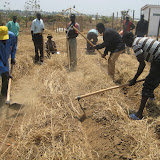
Small steps forward for this method of conservation agriculture in which soil fertility and scarce water is kept and increased both by not plowing and by covering the ground with a layer of mulch; and by adding natural fertilizers like composted grass and manure. FGW incorporates principles from observing Creation and from the Bible that works well to teach these methods in the villages of south Sudan. I held a workshop February 16 for 19 UM pastors and assistant pastors (I expected 10!) to introduce them to FGW; as a result, so far two pastors (from Logo and Mirodu villages) reporting to me that they have prepared a sample plot using these methods and are ready for me to supply them with maize (corn) seed so they can try it out! This makes me very happy. As of today I am proud to announce that Eden Teaching Farm of the Sudan District has officially begun what the new UN report on agroecology (conservation agriculture) calls "decentralized participatory research."
Not only that, but these methods may help Darfur in the north of Sudan. I've had a couple detailed email exchanges with a colleague in Darfur who hopes to use these methods there, and have tried to help her figure out how to adapt the the FGW methods to that area which has drier climate and scarcer resources than we in the south. I'm eager to see what may work there.
Steps forward on the global scene too: I've just discovered a new UN report (December 2010) advocating strongly for increasing the practice and scale of agroecology to increase food security and help small farmers worldwide; and a decision by the Food and Agriculture Organization (FAO) of the U.N. in June 2010 to promote this "integrated holistic approach" for sustainable crop intensification. They even mention the importance of "learning by doing" and of partnering with non-governmental groups at the local level. So far the farming methods we are beginning here is not yet widely accepted or practiced in Sudan, but this tells me it will be promoted more and more. I'm encouraged in my work and thankful to be helping the villages and churches we work with to be involved at the beginning of an important movement.
Steps Forward in Development Hearts and Minds, too
We (mostly Diantha due to my limited mobility on motorcycles) have now completed basic strategic planning meetings in 13out of 17 villages, a process we began last September. We had no idea it would take so long! But we're excited by what's happening. We invite each church to choose an initial project that must meet 4 criteria: (1) It must address a top priority identified by the village during the planning meeting (2) It must involve investment by the village of labor, materials, or both (3) It must require no more than US $150 from us (4) It must be able to be started soon and completed in 4 months or less, so that the church and village have an immediate sense of succeeding in the long path to development. The results are interesting: Three churches have chosen an initial project in agricultural training because they reason that increased production will mean they have more food not only to eat but to sell to get money for school fees, medicines, and other crucial needs. Seven churches have chosen to build an additional school "building" (simply a thatched roof) so they can move more classes from under the trees and expand the number of village children who can be educated (for many of these children the church school is their only option as they cannot afford the higher fees of the government schools, which also may be too far away to walk to). And one church has chosen to build latrines so that their school children can improve their health. One church wants help to get culverts in the road to make it passable in the rainy season and allow their children to walk to school even in the rainy season. The reasoning behind their choices are gratifying. So are, increasingly, the comments made during the planning process. We always ask early on in the meeting for a list of things people are thankful for, as well as (inevitably) a list of what they need. During the first planning meetings last fall, the lists were predictable: they were thankful for their church and the local school the church had begun, the seeds and tools they have been given, the bore hole (deep well) dug with funds from US churches. But since the Referendum in January, the list of thanksgivings have been changing and deepening. We hear thanks for the Referendum, thanks for freedom and peace; and we often hear thanks for the improved life of women. Women are thankful for liberation from the fear that a harsh version of sharia (islamic) law could be imposed on them; thankful that the new government is making a commitment to the rights of women including making women 50% of all government leaders; thankful for a focus on decreasing gender based violence. While the villages and the churches, like the towns and the government, still have a long way to go to put all these changes into practice, its great to hear the excitement and hope in these comments. We feel privileged to be here, doing this, at this time.
Small steps forward for this method of conservation agriculture in which soil fertility and scarce water is kept and increased both by not plowing and by covering the ground with a layer of mulch; and by adding natural fertilizers like composted grass and manure. FGW incorporates principles from observing Creation and from the Bible that works well to teach these methods in the villages of south Sudan. I held a workshop February 16 for 19 UM pastors and assistant pastors (I expected 10!) to introduce them to FGW; as a result, so far two pastors (from Logo and Mirodu villages) reporting to me that they have prepared a sample plot using these methods and are ready for me to supply them with maize (corn) seed so they can try it out! This makes me very happy. As of today I am proud to announce that Eden Teaching Farm of the Sudan District has officially begun what the new UN report on agroecology (conservation agriculture) calls "decentralized participatory research."
Not only that, but these methods may help Darfur in the north of Sudan. I've had a couple detailed email exchanges with a colleague in Darfur who hopes to use these methods there, and have tried to help her figure out how to adapt the the FGW methods to that area which has drier climate and scarcer resources than we in the south. I'm eager to see what may work there.
Steps forward on the global scene too: I've just discovered a new UN report (December 2010) advocating strongly for increasing the practice and scale of agroecology to increase food security and help small farmers worldwide; and a decision by the Food and Agriculture Organization (FAO) of the U.N. in June 2010 to promote this "integrated holistic approach" for sustainable crop intensification. They even mention the importance of "learning by doing" and of partnering with non-governmental groups at the local level. So far the farming methods we are beginning here is not yet widely accepted or practiced in Sudan, but this tells me it will be promoted more and more. I'm encouraged in my work and thankful to be helping the villages and churches we work with to be involved at the beginning of an important movement.
Steps Forward in Development Hearts and Minds, too
We (mostly Diantha due to my limited mobility on motorcycles) have now completed basic strategic planning meetings in 13out of 17 villages, a process we began last September. We had no idea it would take so long! But we're excited by what's happening. We invite each church to choose an initial project that must meet 4 criteria: (1) It must address a top priority identified by the village during the planning meeting (2) It must involve investment by the village of labor, materials, or both (3) It must require no more than US $150 from us (4) It must be able to be started soon and completed in 4 months or less, so that the church and village have an immediate sense of succeeding in the long path to development. The results are interesting: Three churches have chosen an initial project in agricultural training because they reason that increased production will mean they have more food not only to eat but to sell to get money for school fees, medicines, and other crucial needs. Seven churches have chosen to build an additional school "building" (simply a thatched roof) so they can move more classes from under the trees and expand the number of village children who can be educated (for many of these children the church school is their only option as they cannot afford the higher fees of the government schools, which also may be too far away to walk to). And one church has chosen to build latrines so that their school children can improve their health. One church wants help to get culverts in the road to make it passable in the rainy season and allow their children to walk to school even in the rainy season. The reasoning behind their choices are gratifying. So are, increasingly, the comments made during the planning process. We always ask early on in the meeting for a list of things people are thankful for, as well as (inevitably) a list of what they need. During the first planning meetings last fall, the lists were predictable: they were thankful for their church and the local school the church had begun, the seeds and tools they have been given, the bore hole (deep well) dug with funds from US churches. But since the Referendum in January, the list of thanksgivings have been changing and deepening. We hear thanks for the Referendum, thanks for freedom and peace; and we often hear thanks for the improved life of women. Women are thankful for liberation from the fear that a harsh version of sharia (islamic) law could be imposed on them; thankful that the new government is making a commitment to the rights of women including making women 50% of all government leaders; thankful for a focus on decreasing gender based violence. While the villages and the churches, like the towns and the government, still have a long way to go to put all these changes into practice, its great to hear the excitement and hope in these comments. We feel privileged to be here, doing this, at this time.
Monday, August 23, 2010
First week in Africa
Sunday, August 15
The week before we leave for Africa has been one of disinvestment. The phone broke, and we bought a $13 replacement phone at the drug store. Then just after getting the muffler and side mirror fixed, the car broke down and we were told it needs a new engine. We sold it for parts. The same week we met with the people who came from Florida to discuss buying our house; even though they ended up deciding not to buy it right now, Diantha and I went through the emotional process of letting go the house we built and raised our kids in for 19 years. When I mentioned at work how much was breaking down all at once, one woman immediately replied that the devil was trying to disrupt our lives. But I that's not the way I see it. For several years I have been pondering Jesus' repeated reminder that if anyone would follow him, they must “Deny yourself, take up your cross and follow me:” and now I finally feel these words taking shape inside me. I have by no means come close to selling all or denying all, but its the furthest I've ever gone.
Monday, August 16
A dozen Christian friends from as far away as Chattanooga, Greeneville and Kingsport drive several hours and gather at the airport in Alcoa to send Diantha and I off. At my request we form a circle and each friend gives us a hope they have for Sudan that we can take with us: lasting peace, courage and joy, a home for orphans, healing and wholeness out of brokenness. When its my turn, I say my hope is that the people of Sudan have patience to work at the long hard task of rebuilding their lives and nation, and patience to keep choosing this path rather than violence. At the end we pray for all these hopes to be fulfilled.
Tuesday, August 17
Arriving at the airport in Entebbe, Uganda we spot the man with the sign for the Fairway Hotel here the staff at East Africa Annual Conference has arranged for us to stay. It turns out the promised hotel shuttle has left some time ago with a group from an earlier flight, so hotel guy Abdul has contracted with a private van-taxi to drive us the 40 miles to our hotel in Kampala. We load the bags in the van, and Abdul disappears! As the young driver pulls out of the airport, I realize we are totally at the mercy of someone with whom we have no sense of accountability, in a place totally new and strange to us. Suddenly I feel much more vulnerable than I have on the whole trip so far and I'm pushed further than ever to trust God for protection. I pray.
Wednesday, August 18
We have an amazingly good first night sleep and get up in time to meet Robert Kisubi who takes us to our appointment with Bishop Daniel Wandabula at East Africa Annual Conference. Bishop brings in 4 staff and 2 District Superintendents, we all introduce ourselves, then he gives us a quick history of EAAC. When we're asked to make remarks, we share our vision for mission service in Sudan emphasizing a grassroots planning process ineach church and village out of which projects in health, agriculture, microenterprise will come. We talk about the importance of integrating literacy into all these projects, of working collaboratively with other missions, NGOs, and government groups. The strength with which the Bishop and staff affirm this vision amazes us. We ask for patience since this longer-range approach will take time to bring results, and they quickly agree. Hallelujah! Then we go to get our money changed, buy cell phones, and even have time to check out the International Hospital.
Thursday, August 19
The driver sent by EACC is a little late, but we still get all our planned shopping done in a half day! We are extremely grateful that we've had several conversations with Boo and Phyllis Hankins, already in Sudan, about what is most important to buy in Kampala and where to get it. We take the driver to lunch back at the hotel cafe, and repack our bags because we can only take two carry-on items and a 22 pound checked bag on the small Eagle Air plane to Yei. Then the driver takes us to the EAAC offices again to leave 4 big suitcases and the stuff we've just bought, including a two-burner gas hot top to cook on, a printer for our computer, and 2 pillows to be brought later in September on the UMCOR truck that will bring furnishings for the Hankins' new house. After having worked hard at getting rid of so many possessions as we left home that we should have divested long ago, it feels funny to both of us to be buying things for our new (rented) home in Sudan; but we've planned carefully to get the minimum stuff needed to enable us to carry on our missionary service.
Friday, August 20
It's Diantha's 58th birthday, and things have gone so smoothly we have nothing we have to get done today! Anne Travis has emailed that we should rest while we are in Kampala, and this day we can. We sleep in a little, have a late breakfast, then go to the desk to ask about walking to a museum we have heard is nearby. The desk clerks all urge us to take a taxi, saying walking is too dangerous; after the last two days being driven around Kampala I believe them. As one of the desk clerks, a young woman, walks us down to taxi stand at the gate, she complements Diantha on dressing modestly like an African woman, perhaps an unspoken contrast to the tank-topped Italian tourists who clogged the lobby this morning. Diantha tells her that our daughter made the dress she is wearing, and the young woman is surprised we have a daughter old enough to make such a beautiful dress. The clerk is more surprised when Diantha tells her how old she is and how long we've been married, and she comments that it must be a happy marriage from the way she's seen us interact over several days. It strikes me how much we witness without realizing it, by the way we act in parts of our lives we don't think about as the witness parts.
Saturday, August 21
We rise at 2:15 am because the hotel staff insist we have to get to the Entebbe airport 3 hours before the 7:00 am time we have been told to show up at the gate. The reason, they say, is that following the bombing of the soccer club in Kampala several weeks ago, security has been much tighter and it takes longer to go through security at the airport. So the hotel van races through abandoned streets in the wee hours, we breeze through security, and sit for three hours waiting for the ticket counter to open. Its the only time the people we've been relying on in Uganda have been wrong, so we forgive them though we can't really make up the sleep on the hard plastic chairs of the waiting room. Right at 7 am, the missionaries from the UK John and Poppy Spens walk into the airport and I'm delighted to introduce them to Diantha. Poppy is carrying a portable ultrasound machine back to the Martha Clinic in Yei, and she and Diantha immediately begin talking about health care matters while John and I find we share a strong interest in getting the various mission efforts in Yei to collaborate in more concrete ways. As we settle into the little 19-passenger plane, Diantha turns to me and says, “There's no turning back now.” Actually, there hasn't been for some time, but it really sinks in then. I make sure she sits by a window, and she notices the difference in the abundant, organized farms of Uganda and the scarce cultivation when we cross into Sudan. The plane's smooth landing amazes her too, and then we get out onto the red maram clay landing strip and hug Boo and Phyllis.
After Boo and Phyllis have taken us from the airport to the UMCOR guest house where they and we will stay, we finally have an hour or so to make up a little sleep. Then at 2:00 pm we splash water on our face and walk to the new little meeting hut built in front of the guest house where the Sudanese United Methodist pastors have begun to gather. Eventually 14 of the 16 show up, a good turnout, for what we realize is a reception to welcome us! We speak briefly about our hopes and plans for mission service, and then one by one most of the pastors speak, some briefly and some at length and some practically preaching a whole sermon. They have been praying for us to come, they are joyful that we are here, they are thankful that the Church has sent us to help them, they have great hopes and expectations for the impact we can have. I'm actually kind of scared (I find out later Diantha is too) by the immensity of their expectations. As the hour and a half of sharing and prayer ends, I tell them that there is so much to do that I am aware it impossible for us to do it out of our own abilities; BUT that I know three things: with God all things are possible; that needed change will happen as we are partners with each other, each teaching the other what we know; and that though I don't completely understand it, I believe God has a great purpose for Sudan of which we are all together a part.
The more I reflect on this welcome, the more I am blown away by the first step of trust the pastors have placed in us. Thank you, God.
Sunday, August 22
I've been looking forward to worship at Yei United Methodist Church, especially because it will be Diantha's first time to worship in a Sudanese church. Sure enough, I watch her enjoyment build to ecstasy when at the first “hot song” the children rush up to grab her hand and dance, jumping up and down with her. In fact, she has several children holding each of her hands. I get teary when I see her glowing face, and realize she is taking the time to look into the face of each child dancing with her. I'm seeing Jesus taking the time for each little child.
The week before we leave for Africa has been one of disinvestment. The phone broke, and we bought a $13 replacement phone at the drug store. Then just after getting the muffler and side mirror fixed, the car broke down and we were told it needs a new engine. We sold it for parts. The same week we met with the people who came from Florida to discuss buying our house; even though they ended up deciding not to buy it right now, Diantha and I went through the emotional process of letting go the house we built and raised our kids in for 19 years. When I mentioned at work how much was breaking down all at once, one woman immediately replied that the devil was trying to disrupt our lives. But I that's not the way I see it. For several years I have been pondering Jesus' repeated reminder that if anyone would follow him, they must “Deny yourself, take up your cross and follow me:” and now I finally feel these words taking shape inside me. I have by no means come close to selling all or denying all, but its the furthest I've ever gone.
Monday, August 16
A dozen Christian friends from as far away as Chattanooga, Greeneville and Kingsport drive several hours and gather at the airport in Alcoa to send Diantha and I off. At my request we form a circle and each friend gives us a hope they have for Sudan that we can take with us: lasting peace, courage and joy, a home for orphans, healing and wholeness out of brokenness. When its my turn, I say my hope is that the people of Sudan have patience to work at the long hard task of rebuilding their lives and nation, and patience to keep choosing this path rather than violence. At the end we pray for all these hopes to be fulfilled.
Tuesday, August 17
Arriving at the airport in Entebbe, Uganda we spot the man with the sign for the Fairway Hotel here the staff at East Africa Annual Conference has arranged for us to stay. It turns out the promised hotel shuttle has left some time ago with a group from an earlier flight, so hotel guy Abdul has contracted with a private van-taxi to drive us the 40 miles to our hotel in Kampala. We load the bags in the van, and Abdul disappears! As the young driver pulls out of the airport, I realize we are totally at the mercy of someone with whom we have no sense of accountability, in a place totally new and strange to us. Suddenly I feel much more vulnerable than I have on the whole trip so far and I'm pushed further than ever to trust God for protection. I pray.
Wednesday, August 18
We have an amazingly good first night sleep and get up in time to meet Robert Kisubi who takes us to our appointment with Bishop Daniel Wandabula at East Africa Annual Conference. Bishop brings in 4 staff and 2 District Superintendents, we all introduce ourselves, then he gives us a quick history of EAAC. When we're asked to make remarks, we share our vision for mission service in Sudan emphasizing a grassroots planning process ineach church and village out of which projects in health, agriculture, microenterprise will come. We talk about the importance of integrating literacy into all these projects, of working collaboratively with other missions, NGOs, and government groups. The strength with which the Bishop and staff affirm this vision amazes us. We ask for patience since this longer-range approach will take time to bring results, and they quickly agree. Hallelujah! Then we go to get our money changed, buy cell phones, and even have time to check out the International Hospital.
Thursday, August 19
The driver sent by EACC is a little late, but we still get all our planned shopping done in a half day! We are extremely grateful that we've had several conversations with Boo and Phyllis Hankins, already in Sudan, about what is most important to buy in Kampala and where to get it. We take the driver to lunch back at the hotel cafe, and repack our bags because we can only take two carry-on items and a 22 pound checked bag on the small Eagle Air plane to Yei. Then the driver takes us to the EAAC offices again to leave 4 big suitcases and the stuff we've just bought, including a two-burner gas hot top to cook on, a printer for our computer, and 2 pillows to be brought later in September on the UMCOR truck that will bring furnishings for the Hankins' new house. After having worked hard at getting rid of so many possessions as we left home that we should have divested long ago, it feels funny to both of us to be buying things for our new (rented) home in Sudan; but we've planned carefully to get the minimum stuff needed to enable us to carry on our missionary service.
Friday, August 20
It's Diantha's 58th birthday, and things have gone so smoothly we have nothing we have to get done today! Anne Travis has emailed that we should rest while we are in Kampala, and this day we can. We sleep in a little, have a late breakfast, then go to the desk to ask about walking to a museum we have heard is nearby. The desk clerks all urge us to take a taxi, saying walking is too dangerous; after the last two days being driven around Kampala I believe them. As one of the desk clerks, a young woman, walks us down to taxi stand at the gate, she complements Diantha on dressing modestly like an African woman, perhaps an unspoken contrast to the tank-topped Italian tourists who clogged the lobby this morning. Diantha tells her that our daughter made the dress she is wearing, and the young woman is surprised we have a daughter old enough to make such a beautiful dress. The clerk is more surprised when Diantha tells her how old she is and how long we've been married, and she comments that it must be a happy marriage from the way she's seen us interact over several days. It strikes me how much we witness without realizing it, by the way we act in parts of our lives we don't think about as the witness parts.
Saturday, August 21
We rise at 2:15 am because the hotel staff insist we have to get to the Entebbe airport 3 hours before the 7:00 am time we have been told to show up at the gate. The reason, they say, is that following the bombing of the soccer club in Kampala several weeks ago, security has been much tighter and it takes longer to go through security at the airport. So the hotel van races through abandoned streets in the wee hours, we breeze through security, and sit for three hours waiting for the ticket counter to open. Its the only time the people we've been relying on in Uganda have been wrong, so we forgive them though we can't really make up the sleep on the hard plastic chairs of the waiting room. Right at 7 am, the missionaries from the UK John and Poppy Spens walk into the airport and I'm delighted to introduce them to Diantha. Poppy is carrying a portable ultrasound machine back to the Martha Clinic in Yei, and she and Diantha immediately begin talking about health care matters while John and I find we share a strong interest in getting the various mission efforts in Yei to collaborate in more concrete ways. As we settle into the little 19-passenger plane, Diantha turns to me and says, “There's no turning back now.” Actually, there hasn't been for some time, but it really sinks in then. I make sure she sits by a window, and she notices the difference in the abundant, organized farms of Uganda and the scarce cultivation when we cross into Sudan. The plane's smooth landing amazes her too, and then we get out onto the red maram clay landing strip and hug Boo and Phyllis.
After Boo and Phyllis have taken us from the airport to the UMCOR guest house where they and we will stay, we finally have an hour or so to make up a little sleep. Then at 2:00 pm we splash water on our face and walk to the new little meeting hut built in front of the guest house where the Sudanese United Methodist pastors have begun to gather. Eventually 14 of the 16 show up, a good turnout, for what we realize is a reception to welcome us! We speak briefly about our hopes and plans for mission service, and then one by one most of the pastors speak, some briefly and some at length and some practically preaching a whole sermon. They have been praying for us to come, they are joyful that we are here, they are thankful that the Church has sent us to help them, they have great hopes and expectations for the impact we can have. I'm actually kind of scared (I find out later Diantha is too) by the immensity of their expectations. As the hour and a half of sharing and prayer ends, I tell them that there is so much to do that I am aware it impossible for us to do it out of our own abilities; BUT that I know three things: with God all things are possible; that needed change will happen as we are partners with each other, each teaching the other what we know; and that though I don't completely understand it, I believe God has a great purpose for Sudan of which we are all together a part.
The more I reflect on this welcome, the more I am blown away by the first step of trust the pastors have placed in us. Thank you, God.
Sunday, August 22
I've been looking forward to worship at Yei United Methodist Church, especially because it will be Diantha's first time to worship in a Sudanese church. Sure enough, I watch her enjoyment build to ecstasy when at the first “hot song” the children rush up to grab her hand and dance, jumping up and down with her. In fact, she has several children holding each of her hands. I get teary when I see her glowing face, and realize she is taking the time to look into the face of each child dancing with her. I'm seeing Jesus taking the time for each little child.
Subscribe to:
Posts (Atom)